
Editorial Article
Four Acquisitions, a USD 5 Billion Valuation, and Still No Consolidator: Why Parking Refuses to Concentrate
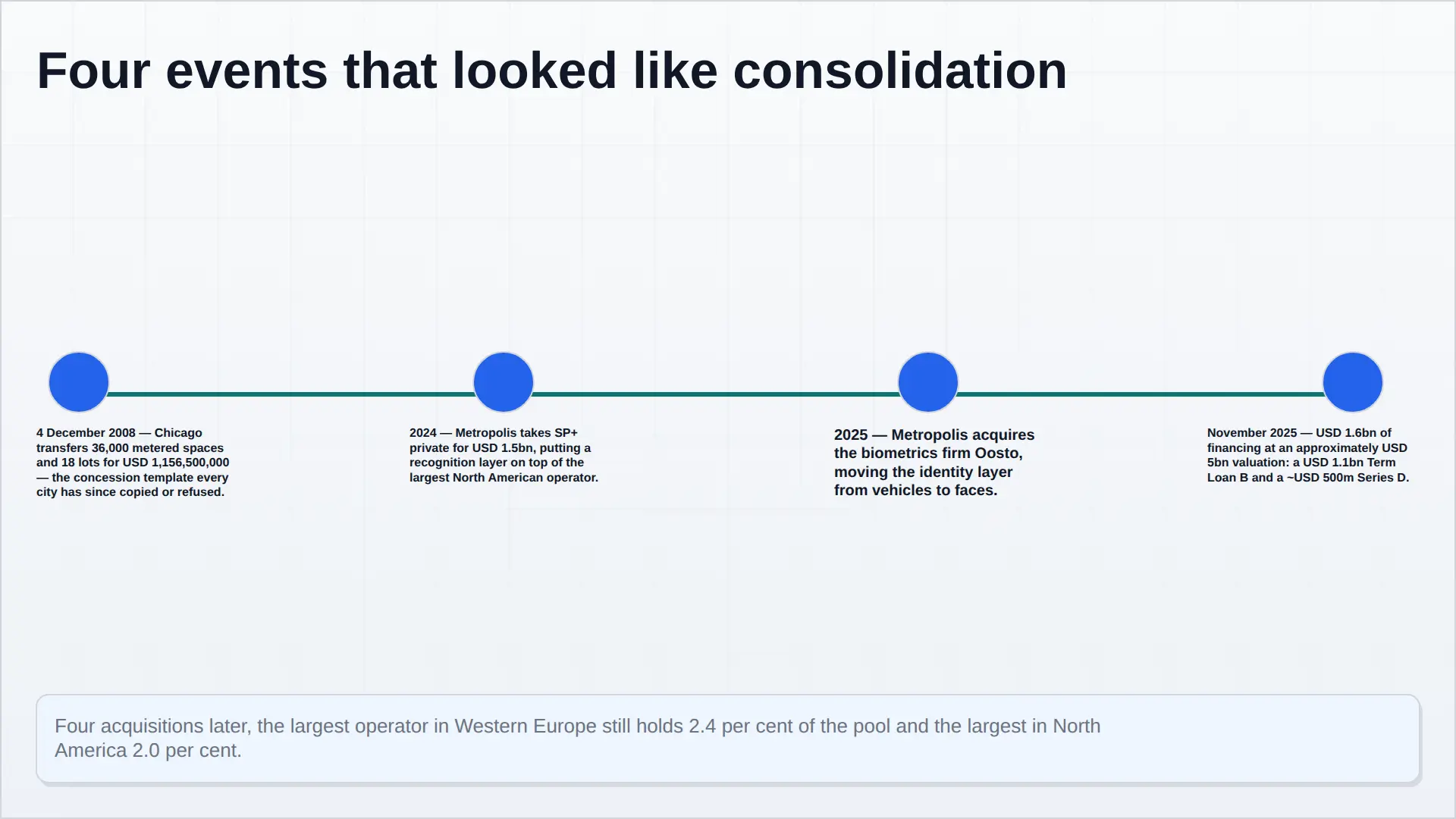
A company with no car parks raised USD 1.6 billion in November 2025 at a valuation of roughly USD 5 billion, having already spent USD 1.5 billion taking the largest North American parking operator private. It reports more than USD 5 billion of annual transaction volume, 50 million customers and nearly 20 million members. Add the 2025 acquisition of a biometrics firm and the picture looks like consolidation arriving in an industry that has never had a consolidator.
Then read the market share. The largest operator in Western Europe holds 2.4 per cent of the operator-recognised pool. The largest in North America holds 2.0 per cent. Ten profiled operators combined hold somewhere between 13 and 17 per cent, and even that figure is a Pheonix estimate rather than an arithmetic sum, because six of the ten do not disclose anything that permits a revenue comparison. The pool was USD 43,780 million in 2025 and reaches USD 78,900 million in 2033.
So the most acquisitive decade in the industry’s history has produced a market in which no participant is large enough to influence the price. That is not an anomaly to be explained away. It is the structural fact of this market, and it follows directly from what is actually being sold.
What a consolidation buys, and why it cannot be bought
In a normal fragmented industry, fragmentation is a roll-up opportunity: buy the smaller operators, take out duplicated overhead, and the combined entity earns more than the parts. Parking looks like that and is not.
What an operator owns is not the car park. It is the right to operate the car park for a period of years, granted by whoever holds the freehold — a city, an airport authority, a pension fund, a property company, a family. Those rights are not traded in a market. They are granted through a procurement, and they come back to the grantor at expiry. Buying an operator buys the remainder of its contracts, not the contracts’ renewal. The moment the term ends, the buyer owns a workforce, a brand and a systems estate, and it has to bid again against everyone else.
That is why acquisition in this sector so often produces scale without share. The asset being purchased has a decay curve built into it, and the price paid assumes a renewal rate that the grantor has no obligation to honour.
The clearest illustration is not a takeover but a transfer. On 4 December 2008 the City of Chicago handed over 36,000 metered spaces and 18 parking lots for USD 1,156,500,000. What the city sold was the right to collect a tariff for a fixed period. It did not sell a business that could be consolidated with another one; it sold a term. Every city that has done this since has done the same thing, and every one retains the ability to do something different at the end of it.
The grant is a political act, not a commercial one
The second reason the market resists concentration is that the decision to grant is made by people who are accountable to voters rather than to a board, and the terms that make an operator rich are the terms that make a council unpopular.
The clearest current example is not a pricing dispute but an environmental rule. Directive (EU) 2024/1275, Article 14, requires that from 1 January 2027 existing non-residential car parks above 20 spaces provide one recharging point per ten spaces, or the ducting to install 50 per cent of them later. That is a capital obligation falling on whoever holds the asset at that date. In our interview programme it reopened the contract conversation on 41 per cent of the concessions discussed — not because the regulation is unreasonable, but because it changed who should pay for something, and the answer to that question is decided by the contract.
A market where a single directive can reopen two fifths of the live contracts is not a market in which a buyer can underwrite a twenty-year revenue stream. It is a market of renegotiation cycles. Consolidators who treat those cycles as noise will overpay; those who treat them as the asset’s actual risk profile will bid lower than the incumbents and lose.
The transaction left the site, which decouples scale from share
If the operator layer cannot concentrate, something else can. The most important disclosure in this market in the last three years is not a market share figure. It is SP+’s own statement that it recorded 120 standalone technology deployments in a single year at sites that buy none of its services, in the same year it reported 94 per cent location retention.
Both facts are true simultaneously and together they are the competitive problem in two numbers. The operator keeps the site. Somebody else takes the transaction. The recognition layer sits between the driver and the tariff, and it earns from the transaction whether or not the operator holds the lease.
This is why the ancillary and technology-attached arm of the pool grows at 12.58 per cent against 5.78 per cent for lease and concession, lifting its share from 17.1 per cent to 24.5 per cent and supplying 33.7 per cent of all incremental value. If consolidation is happening anywhere in this industry, it is happening there — at the layer that touches the payment, not the layer that employs the staff. A company can become the standard for how a car park is paid for without owning a single car park, and that is a far easier thing to scale than a portfolio of municipal concessions.
The one operator that scaled by going sideways
There is a second route visible in the disclosures, and only one company has taken it seriously. Park24 reported 1,357,393 bays, of which 543,793 — 40.1 per cent — were outside Japan. That is not a portfolio of long-dated concessions in a single jurisdiction. It is a capital-light network assembled in smaller, shorter, more granular parcels across several markets, where the growth comes from adding locations rather than from winning contracts of scale.
The trade-off is explicit. Bay-by-bay growth does not produce the operating leverage a roll-up does, and it does not produce the margin a long lease produces. What it produces is a business that is not hostage to a single procurement calendar — and in a market where a directive can reopen 41 per cent of the contracts in a year, that is worth something a share price does not immediately show.
What would actually consolidate this market
Three things could, and only one of them looks like a takeover.
Contract aggregation at the city level. If grantors start packaging their entire on-street and off-street estate into a single concession — as Chicago did for its meters and lots — the winning bidder acquires share in one transaction rather than fifty. This is the only route to genuine concentration, and it is controlled entirely by the public sector.
The transaction layer taking the fee. Recognition, reservation and validation become the point of payment, and the operator becomes a facilities provider on a fixed fee. Concentration then happens above the operator, and the operator’s margin compresses toward a services margin — which, at 8.8 per cent, is where part of the market already is.
Vertical combination of operator and technology. Which is precisely what the SP+ take-private and the subsequent biometrics acquisition represent: a company buying distribution for a recognition layer rather than buying a parking business. The interesting question is not whether it works financially. It is whether a technology-led owner can earn a leaseholder’s margin on assets it did not have to bid for.
The falsifiers
Two things would break the argument that this market stays structurally fragmented. The first is a wave of city-level estate concessions in the 2027–2031 window, as the charging directive forces asset owners to recapitalise and some decide to transfer the problem instead of funding it. The second is a change in grantor behaviour toward longer terms with indexed revenue shares, which would make the contracts underwritable and therefore acquirable.
Neither is in the current evidence. Both are worth watching precisely because the industry’s own explanation for its acquisitions — that scale is finally arriving — depends on one of them happening.
How this was researched
This analysis is built on 70 per cent secondary research and 30 per cent primary research conducted by Pheonix. The primary programme comprised 38 semi-structured interviews across seven markets, 11 conference-floor interviews, two asset-owner roundtables and a 64-response operator survey. The 13–17 per cent combined share of the ten profiled operators, the 41 per cent contract-reopening figure and all market sizing are Pheonix constructions or estimates and are labelled as such in the underlying report; every company figure traces to that company’s own disclosure.
References
- SP+, Form 10-K and Q4/FY2023 results release — 120 standalone technology deployments, 94 per cent location retention, services revenue and GAAP operating income.
- Q-Park, Annual CSR Report 2024 — net revenue, operating result, capex funded from operating cash flow.
- Park24, FY10/2024 Data Book — 1,357,393 bays, of which 543,793 overseas (40.1 per cent).
- Metropolis, financing announcement, November 2025 — USD 1.6 billion at an approximately USD 5 billion valuation, over USD 5 billion annual transaction volume, 50 million customers, approximately 20 million members.
- City of Chicago, published concession record, 4 December 2008 — 36,000 metered spaces and 18 lots, USD 1,156,500,000.
- Directive (EU) 2024/1275, Article 14 — recharging points and ducting for non-residential car parks from 1 January 2027.
- Pheonix Research, Global Parking Management & Concession Operations Market, 2026–2033 — competitive landscape, contract-form split and sensitivities.