
Editorial Article
The Same Pellet Clears at USD 211 in Amsterdam and USD 145 in Korea
Three prices for one tonne, in one quarter
A Japan-compliant palm kernel shell left east coast Sumatra at about USD 101 a tonne. It landed in Japan at about USD 138. Fifteen of the thirty-seven dollars between those two numbers was the Indonesian state.
That spread is the cleanest available read on how this market prices, because every element of it is disclosed. Argus assessed Japan-compliant palm kernel shells at about USD 101 per tonne FOB east coast Sumatra in December 2025. Indonesian export declarations record 6.06 million tonnes exported for the year, 92 per cent of it to Japan, at about USD 103 per tonne FOB. Japanese buyers paid about USD 138 per tonne CIF in May 2026, down from a peak of about USD 167 in July 2024.
| Component of the USD 37 per tonne | USD per tonne | Who sets it |
|---|---|---|
| Indonesian export duty | 10 | Set monthly against the crude palm oil reference price |
| Plantation fund levy (from 1 March 2026) | 5 | Indonesian statute |
| Freight, certification, margin | 22 | The market |
| Total FOB to CIF spread | 37 | 36.6% of the FOB assessment |
Two things follow. First, the delivered price of a biomass fuel is not the production cost plus freight — a statutory layer sits inside it that is set by a reference price the exporter does not control. Second, that layer is not small: it is the majority of the difference between what the material is worth where it is made and what it costs where it is burned.
A certificate is worth 7.69 per cent, and nothing in the fuel changes
ENplus A1 residential pellets were assessed at EUR 210 per tonne CIF ARA against EUR 195 for industrial I2. The EUR 15 spread — 7.69 per cent — buys a document, not a warmer flame.
Nothing about the energy content of the tonne changes between those two grades. What changes is the chain-of-custody requirement, the fines tolerance, the ash specification and the audit trail. One grade can be sold to a household inside a quality scheme; the other is sold to a plant that will burn it in a boiler designed to be indifferent to small variations in the feedstock.
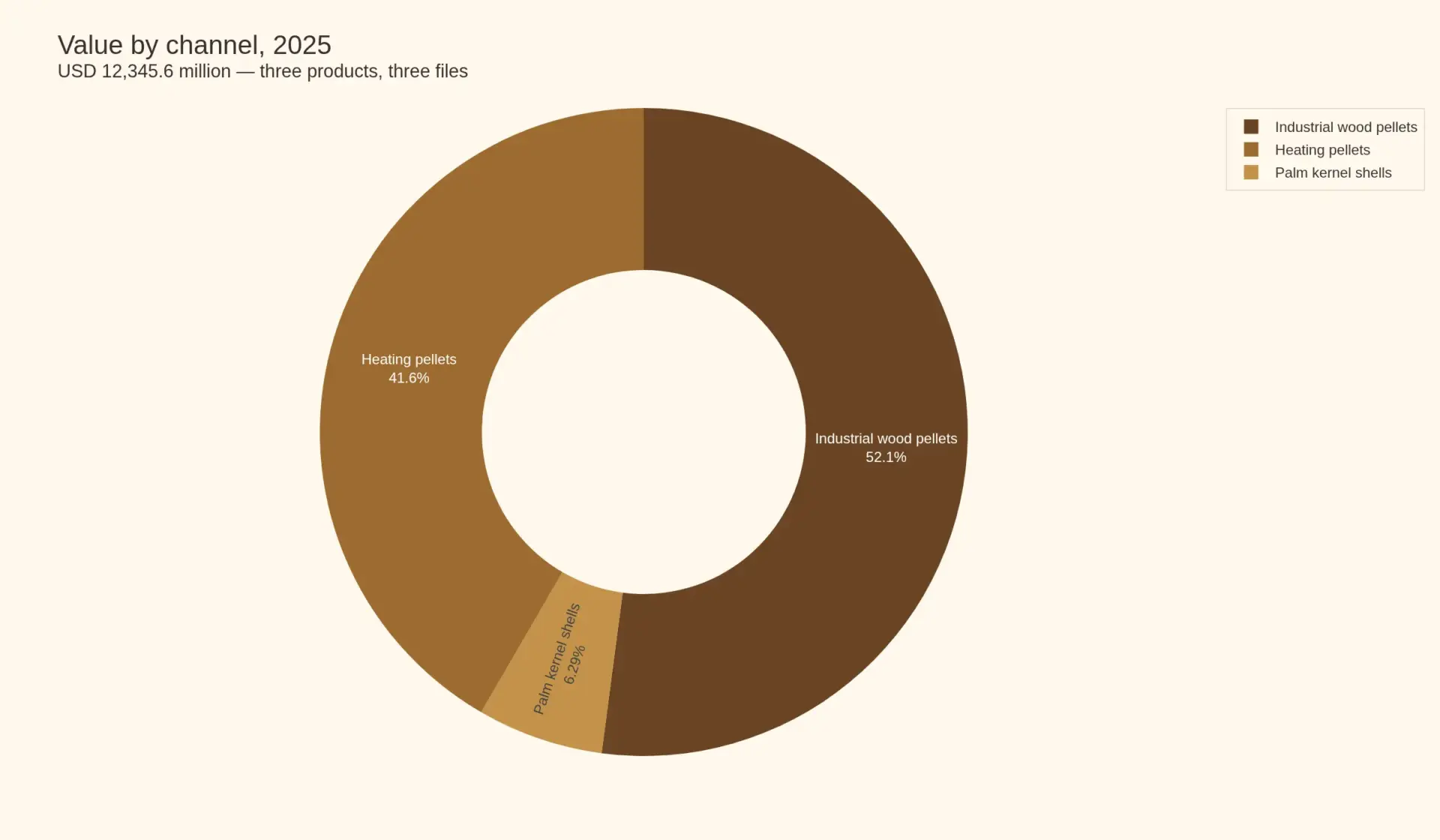
This is the single most misunderstood price relationship in the category, because it looks like a quality premium and behaves like an administrative one. It is also the reason the residential channel — 20.8 million tonnes, 41.63 per cent of the measured market’s value at the highest unit price in it — is the most durable of the three channels and the slowest growing at 5.65 per cent. Households buy certificates they never read.
The cross-basin spread is 1.46, and it is set by policy rather than fibre
Northwest European industrial pellets clear at USD 211 per tonne. South Korean imports average USD 145. Europe is paying 46 per cent more for a tonne it cannot produce enough of.
The European position is a structural deficit: 36.05 million tonnes of consumption against 24.1 million tonnes of production, a shortfall of 11.95 million tonnes that has to arrive by sea. Korea imported 3.91 million tonnes in 2025, down 3 per cent from the 4.015 million tonne record of 2024, while the average import price rose 15 per cent to USD 145 per tonne and the import bill rose 12 per cent to USD 566 million (Lesprom Analytics, 11 February 2026).
Then the policy moved. Korea’s late-2024 Renewable Portfolio Standard amendment ends certificate support for new biomass power plants, ends certificates for state-owned coal-and-biomass co-firing from 2025, phases certificates out for private co-firing from 2026, and reduces the certificate weighting for dedicated biomass plants over time. That is the mechanism that took Korean imports from 122,000 tonnes in 2012 to 3.91 million tonnes in 2025, and it is being dismantled in sequence.
So the two prices are not converging on fibre. They are converging on subsidy. Europe’s premium reflects a compliance file a Korean buyer does not need and, after the amendment, increasingly cannot monetise; Korea’s discount reflects a certificate that no longer pays for itself. A producer who treats the 1.46 multiple as a freight-and-quality spread will misprice both markets.
Where the price is actually set: at the discharge terminal
Combined inventories at monitored Amsterdam, Rotterdam and Antwerp terminals fell 15,500 tonnes — 47 per cent — to around 17,500 tonnes in a single quarter in early 2025, alongside elevated vessel arrivals.
A market with six weeks of visible stock at a major import hub has no buffer against a supply disruption, and the record shows it. Three-quarters of the world’s traded pellet flow lands through a small number of port terminals: the United States exported 10.09 million tonnes in 2025, roughly one tonne in five of global output, organised around a handful of port-linked plants in the Southeast. Throughput at those terminals, not the forests behind them, is the binding constraint.
Which means the delivered price in the largest consuming region is controlled one layer downstream of the plant that makes the fuel. That is the structural fact behind the entire unit-economics argument: the value is created at the mill gate and captured at the port.
What the three prices mean for a decision
Every question in this market turns out to be a pricing decision with a product name attached.
- Where to site. A plant’s competitiveness is set by the delivered cost of its fibre and the distance to a terminal with discharge capacity, not by its capital cost. Georgia’s loss of three major paper mills in under ninety days removed both the residue and a competing buyer in one quarter — a supply event that no pellet plant could see coming and none could hedge.
- Which certificate to carry. Fixed cost per cargo, so the answer differs by an order of magnitude between a 30,000 tonne Handysize cargo and a 2,000 tonne regional lot. This is also the mechanism by which the producer tier consolidates without anyone becoming more efficient.
- Spot or term. With 17,500 tonnes of visible stock across three ports and a 47 per cent quarterly swing behind it, term cover is a purchase of insurance priced against a very thin physical buffer.
- Whether to own a port. The one position in this chain that confers pricing power over the delivered tonne, and the only link that does not depend on a subsidy holding.
And one exposure that sits underneath all four: the EU Emissions Trading System currently applies a zero-rated emissions factor to biomass combustion, which is the entire basis on which a EUR 41.30 per megawatt-hour pellet competes with coal. Any change to that treatment — and the sustainability criteria in EU/2023/2413 are precisely the mechanism by which it could change for a specific cargo — reprices the tonne by more than its own production cost.
How this was built
Two research layers, approximately 70 per cent secondary and 30 per cent primary. The secondary layer carries every number in this piece: Argus assessments for Japan-compliant palm kernel shells, Indonesian export declarations and fiscal instruments, the RBCN market update for ENplus A1 and I2 CIF ARA assessments and ARA stock levels, Lesprom Analytics for Korean import volumes, values and prices by origin, Bioenergy Europe for European production and consumption, and the European Commission’s Directive (EU) 2023/2413 for the sustainability criteria.
The primary layer — producer, trader and port terminal interviews across the Baltic, Iberian, Southeast US and Southeast Asian tiers; buyer-side procurement interviews in Japan, Korea and Northwest Europe; and a buying-criteria exercise establishing the relative weight buyers place on certification, moisture, calorific value and origin — establishes why the FOB-to-CIF spread contains a statutory layer, why a fixed-cost audit consolidates production, and why buyers in Rotterdam and Gunsan price the same product 1.46 apart. It supplies no number of its own.
No other market research firm’s estimate appears in this analysis, in any figure or any reconciliation.
Related research
- Global Biomass Fuel Market Report, Size, Share and Forecast 2026–2033 — the full report: the regional price reconstruction, the three-channel split and the six-chapter analysis behind every figure above.
- Global Pyrolysis Oil Market — the liquid-thermal route out of the same residue streams.
- Global Cement Market — the carbon arithmetic that sets what a substituted tonne is worth to a kiln operator.
- Global Biochar Market — the competing use of the same feedstock, at a materially higher value per tonne.
- Bio-Fuels segment — the full segment view.
Frequently Asked Questions
Why do palm kernel shells cost less than wood pellets when they carry similar energy?
Because the price is attached to the file, not the flame. Palm kernel shells at a blended USD 133.79 per tonne carry a legal-origin document and almost nothing else, against USD 196.62 for an industrial pellet that carries a sustainability and chain-of-custody file a utility can present to a regulator in exchange for a subsidy or a zero emissions factor. There is also no agreed standard method for verifying the biogenic fraction of a mixed fuel, so a fuel whose biogenic content cannot be evidenced cannot be fully credited — a measurement discount rather than a quality discount.
What is the difference between ENplus A1 and industrial I2 pellets?
EUR 15 per tonne, or 7.69 per cent, on CIF ARA assessments of EUR 210 against EUR 195. Nothing in the energy content changes. The difference is the chain-of-custody requirement, the fines tolerance, the ash specification and the audit trail attached to the residential grade — which is why the residential channel can be priced highest per tonne and still be the most durable of the three.
Why are South Korean biomass import prices lower than European prices?
Northwest European industrial pellets clear at about USD 211 per tonne against a South Korean import average of USD 145 — a 1.46 multiple. Europe runs an 11.95 million tonne structural deficit against consumption and pays for a compliance file that a Korean buyer does not need. Korea's late-2024 RPS amendment ends certificate support for new biomass plants and phases out support for co-firing, which removes the mechanism that justified the premium in that market.
How much of a delivered biomass cargo is tax rather than product?
For Japan-compliant palm kernel shells in May 2026, USD 15 of the USD 37 per tonne between the FOB assessment and the delivered CIF price was Indonesian state revenue: a USD 10 export duty set monthly against the crude palm oil reference price, plus a USD 5 plantation fund levy from 1 March 2026. Freight, certification and margin account for the remaining USD 22.