
Editorial Article
The Conformity File Becomes the Licence to Operate in Two Months
On 20 January 2027, Regulation (EU) 2023/1230 applies. From that date, every machine placed on the European market — including every automated storage and retrieval system, every shuttle, every conveyor module and every robot cell — carries an obligation that is paid for before it earns anything: a technical file built to the new essential health and safety requirements, a risk assessment behind it, and a declaration of conformity in front of it.
This is not a story about safety regulation getting stricter, which is the framing most suppliers will use. Safety standards were already strict. What changes is the object of the obligation. The conformity file stops being a document about the machine’s guards and becomes a document about the machine’s behaviour, including the parts of that behaviour that are decided in software.
That shift arrives with a price attached, and the price lands unevenly. It is the most under-priced line in the warehouse automation business, and it is about to become one of the more consequential ones.
What actually changes on 20 January
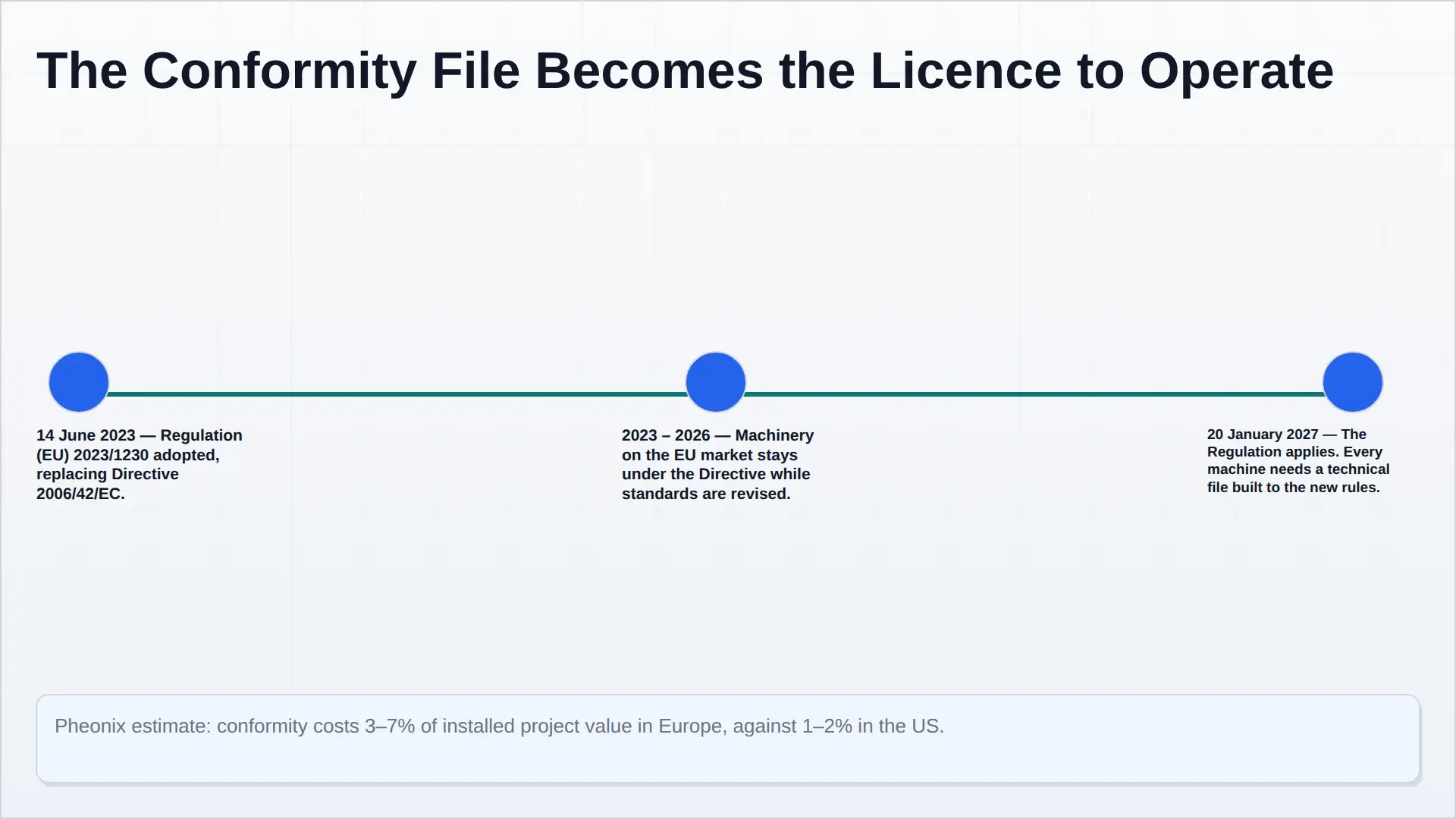
The Regulation replaces Directive 2006/42/EC, the instrument that has governed machinery in Europe since 2009. Machinery already placed on the EU market before 20 January 2027 remains under the Directive; the Regulation governs what is placed from that date onward. The European Commission’s own summary of the change identifies what is genuinely new rather than merely re-codified:
- Safety functions that are AI-powered are brought explicitly inside the conformity assessment. A system whose safety behaviour is learned rather than fixed now has to be assessed as such.
- Cyber-safety of compliance-relevant software and safety control systems becomes part of the file. Unauthorised access to a safety controller is now a safety question, not only an IT question.
- Higher-risk machinery faces a conformity assessment route that can require a notified body, rather than self-declaration alone.
- Digital instructions for use and digital declarations of conformity are permitted under clarified conditions — a genuine administrative saving, and one that is easy to mistake for the whole cost.
- Accident and health-damage reporting: under Article 6(9), Member States must periodically provide data on accidents or damage to health caused by machinery, against a Commission template.
Read that list as a supplier and the tempting conclusion is that the headline cost is documentation. Read it as a buyer and the conclusion is different: the assessment now reaches into the control layer, which is exactly the layer where this industry’s margin has been migrating.
What the file costs
Our estimate, drawn from the primary research programme behind our warehouse automation model — 41 semi-structured interviews across integrators, component vendors and operators, plus open-ended follow-ups and an operator survey — is that conformity costs 3 to 7 per cent of installed project value in Europe, against 1 to 2 per cent in the United States (Pheonix estimate).
The range is wide because the cost is not linear in project value. It is roughly linear in machine variants and novelty, and only weakly related to the size of the site. A single retrofit of one existing aisle with a known machine type is cheap to document relative to its value. A multi-temperature installation with three new machine types, a bespoke control layer and an AI-assisted traffic-management system is expensive relative to its value — and it is also the kind of project the market is growing into, since software and controls are compounding at 17.94 per cent against 8.87 per cent for conveyor and 8.57 per cent for unit-load cranes.
That mismatch is the structural point. The industry is selling more software and more control per installation — revenue per installation goes from USD 3.25m to USD 4.81m in our model, against installation growth of 6.76 per cent — and it is simultaneously selling into a conformity regime that has just extended its reach into software and control. The fastest-growing part of the revenue line is the part with the fastest-growing assessment obligation attached to it.
Why an entry cost behaves like a floor
It is worth being precise about what this is and is not. The Regulation does not set a performance floor. It does not say how fast a shuttle must travel or how many picks an hour a goods-to-person station must achieve. Nothing in the file compels a buyer to pay for capability.
What it creates is an entry cost: a fixed obligation that must be discharged before the first euro of revenue arrives, and which cannot be amortised across a project that never happens. Entry costs behave like floors on the margin, because they reduce the number of credible bidders for any given project without reducing the number of projects. On large, standard, repeatable installations the cost is a nuisance that gets absorbed. On small, novel or retrofit projects it is the difference between quoting and declining — and small, novel and retrofit projects are where new entrants and specialist integrators make their living.
This is the opposite of what happens in consumer electronics, and the contrast is instructive. In consumer imaging there is no assessment of what the product does — conformity regimes exist for electrical safety, radio equipment and batteries, but they govern whether the product hurts anyone, not whether it performs. That is why the average camera body could fall 3.93 per cent in price during a year in which the market grew 11.2 per cent in units. Nothing was obliged to hold the price. In warehouse automation in Europe, something now is: the cost of being allowed to sell at all.
Why the integrator earns 5.96 per cent and the component maker earns 72.4 per cent gross
The margin structure of this industry is usually explained by completion risk, and completion risk is real. But the conformity file is the mechanism through which completion risk becomes a permanent cost line rather than a one-off contingency.
In FY2025, KION’s Supply Chain Solutions segment — Dematic — reported €3,042.8m of revenue at 5.96 per cent adjusted EBIT and 2.80 per cent reported. AutoStore, which sells components to the integrators who carry the site, reported 72.4 per cent gross margin and 43.3 per cent adjusted EBITDA. That gap is not a story about technology. Dematic’s engineers are not less capable than AutoStore’s. The gap exists because one company signs for the site — its schedule, its interfaces, its commissioning, its documentation — and the other sells a cube into someone else’s risk.
Add a conformity regime that reaches into control software and AI-driven safety functions and the imbalance deepens, because the party carrying the site is the party who must evidence the whole system. Working capital already tells the same story from a different angle: across the integrators we track, working capital is growing roughly 4.5 times faster than sales, against capital expenditure of about 3.2 per cent of revenue. The company that carries completion risk is also the company that funds it, and now also the company that documents it.
The retrofit question
The Directive already applied to machinery modified to such an extent that it becomes de facto new machinery, and the Regulation does not loosen that logic. For the retrofit market — which is where much of the affordable end of this industry’s growth sits — the consequence is structural rather than legal.
A retrofit that adds shuttles to an existing rack structure, or replaces a legacy control layer with a modern warehouse execution system, may or may not become a substantial modification depending on what is changed. That determination is a legal judgement with a commercial consequence: if it does, the project inherits a conformity file proportionate to a new machine, and the file is fixed cost against a project that is by definition smaller than a new build. Our estimate of 3 to 7 per cent of installed value is a blended figure; on small retrofit projects in Europe the upper end is not a tail risk, it is the norm when a new machine type or a new control architecture is introduced.
That is one reason the retrofit market is more dependent on established integrators than its underlying economics would suggest. The integrator who has already assessed the machine type and can document an incremental change is not doing the same work as the integrator assessing it for the first time, even though both are quoting the same lanes.
Digital instructions do not solve this
The Regulation’s clarification of digital instructions for use and digital declarations of conformity is a genuine saving and will be sold as one. It reduces the cost of distributing documentation. It does not reduce the cost of producing the assessment the documentation describes — the risk analysis, the validation of safety functions, the cyber-safety evidence for the control layer, and where required the notified body’s involvement.
In our interviews, suppliers consistently underestimated this distinction before their first project under a new regime and consistently overestimated it afterwards on repeat projects. The learning curve is steep and it is per machine type, not per customer. That is a scale advantage for anyone with a broad installed base, and a barrier for anyone without one.
The falsifier
Every regulatory argument has the same weakness: it assumes the rule is enforced. If European market surveillance capacity does not keep pace with the scope of the new assessment — AI-powered safety functions and control-software cyber-safety are not trivial things to inspect — then the file becomes paperwork, buyers stop pricing it, and the cost that should have surfaced as a price floor gets absorbed as margin leakage instead. That would be worse for suppliers than a strict regime, because they would carry the cost without the protection.
The Article 6(9) accident-reporting obligation is the piece most likely to determine which way this goes. A Member State that collects machinery accident data systematically will find it easier to justify inspection capacity than one that does not. Watch the data before watching the guidance.
What to watch
- 20 January 2027 — the application date. Anything placed on the EU market before it stays under Directive 2006/42/EC, which makes the run-up to the date commercially interesting: projects that can be placed in 2026 have an incentive to be.
- Notified body capacity — if higher-risk categories require third-party assessment and queues form, the binding constraint on European deployment in 2027 will be assessment slots, not hardware.
- Harmonised standards revision — voluntary standards give presumption of conformity, and where they lag the Regulation, every project becomes a bespoke argument.
- Member State accident data under Article 6(9) — the leading indicator of whether enforcement has teeth.
Related research
- Global Warehouse Automation & Automated Storage and Retrieval (AS/RS) Market Report, 2026–2033 — the parent report, including the full regulatory chapter and the margin-structure analysis.
- Global Industrial Automation Market Report, 2026–2033 — the wider frame, including automation outside the warehouse.
- Global Robotic Arm Market, 2026–2033 — the component layer where the safety-function question is most acute.
- Global Underwater Robotics Market, 2026–2033 — a parallel case in which assessment obligations, not capability, decide who can sell into regulated environments.
Sources
- European Commission, Directorate-General for Internal Market, Industry, Entrepreneurship and SMEs — Machinery: Regulation (EU) 2023/1230, adopted 14 June 2023, applying on a mandatory basis from 20 January 2027; scope of the essential health and safety requirements; AI-powered safety functions; cyber-safety provisions; higher-risk conformity assessment; digital instructions and declarations; Article 6(9) accident and health-damage data reporting; and the treatment of machinery placed on the market before the application date.
- KION Group, Annual Report 2025 (including Note 41) — Supply Chain Solutions segment revenue and margins.
- AutoStore, Q4 2025 results — gross margin and adjusted EBITDA margin.
- Symbotic, Q4 and FY2025 results; Kardex, Annual Report 2025; Daifuku, FY2025 results presentation; Vanderlande, FY25 annual report.
- Pheonix Research primary research programme: 41 semi-structured interviews, trade-event interviews, twelve open-ended follow-ups and an operator survey. The conformity-burden range of 3 to 7 per cent of installed project value in Europe against 1 to 2 per cent in the United States is a Pheonix estimate, labelled as such wherever it appears.
Frequently Asked Questions
When does the EU Machinery Regulation 2023/1230 apply?
20 January 2027. Machinery placed on the EU market from that date falls under Regulation (EU) 2023/1230; machinery placed on the market before it remains under Directive 2006/42/EC.
What does the conformity file now have to cover?
The essential health and safety requirements, the risk assessment behind them, safety functions that are AI-powered, cyber-safety of compliance-relevant software and safety control systems, and — for higher-risk machinery — a conformity assessment route that can require a notified body.
How much does conformity cost as a share of project value?
Pheonix estimates 3 to 7 per cent of installed project value in Europe against 1 to 2 per cent in the United States, based on 41 semi-structured interviews with integrators, component vendors and operators. The cost is roughly linear in machine variants rather than project size, so it weighs proportionally heaviest on small and retrofit projects.