
Global Vertiport & UAM Ground Infrastructure Market Report, Size, Share and Forecast 2026–2033: The Pad Is the Cheap Part — a Vertiport Is a Grid Connection With a Licence Attached
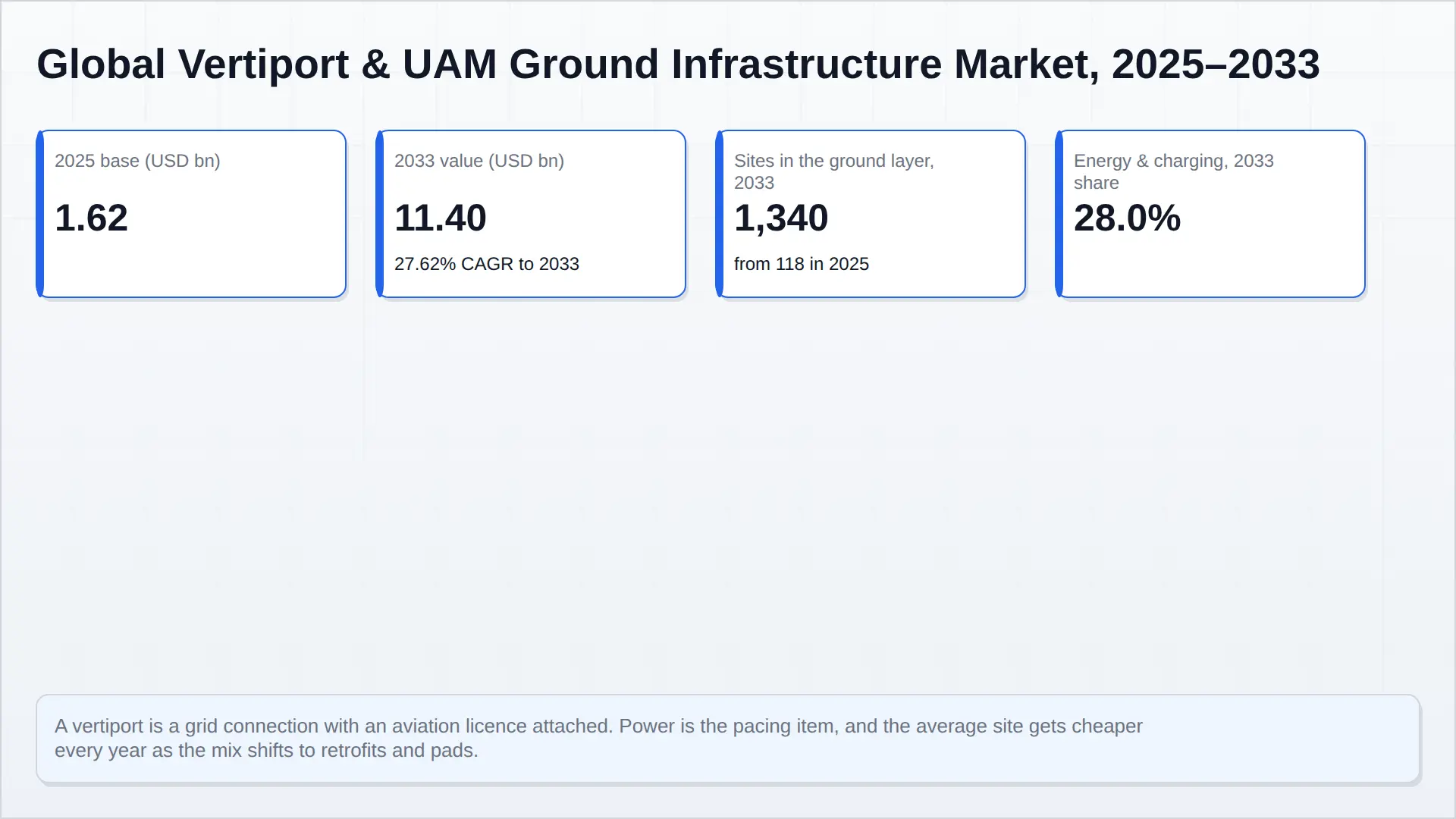
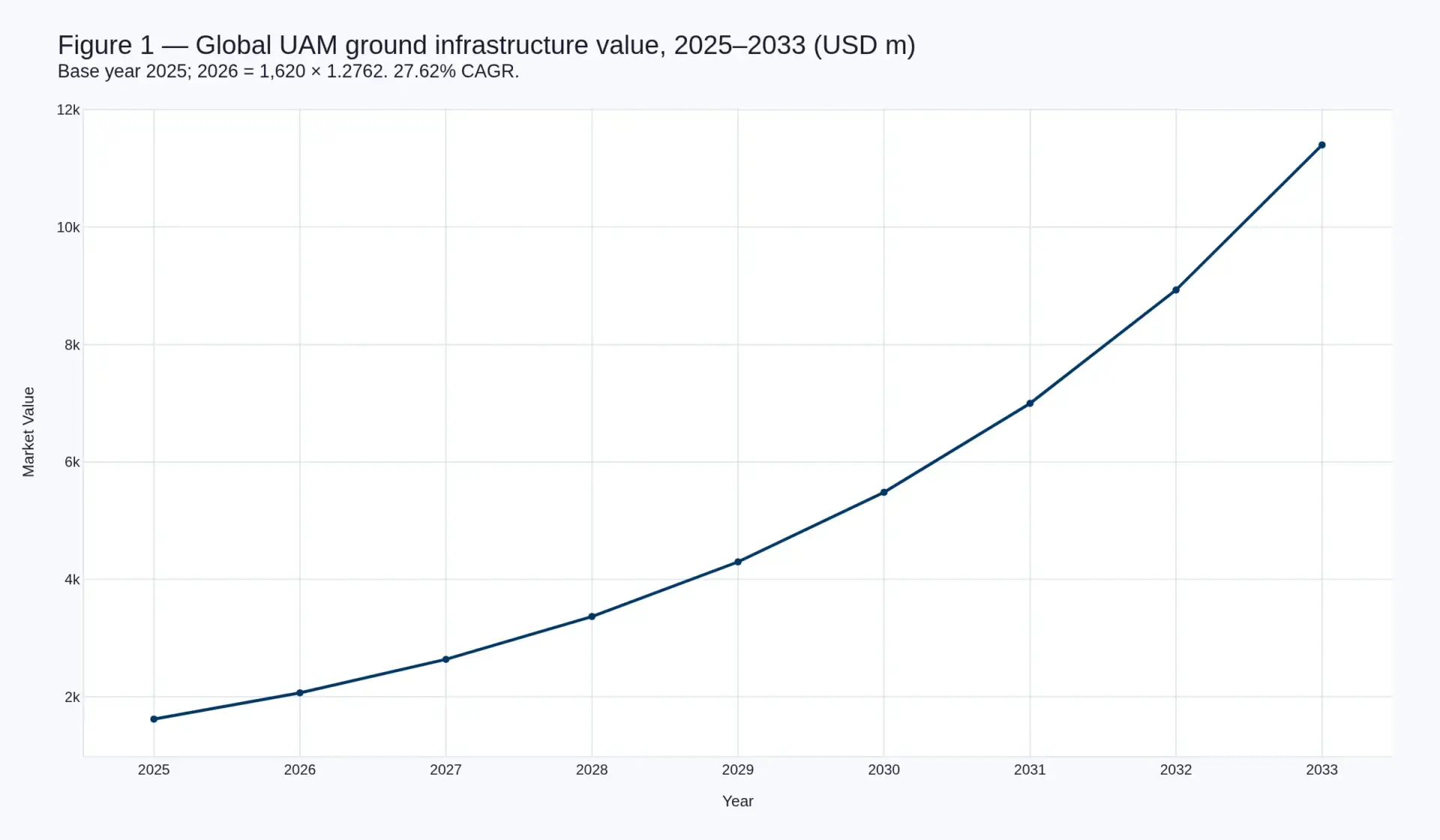
The global market for vertiport and UAM ground infrastructure stood at USD 1.62 billion in 2025 and reaches USD 2.07 billion in 2026, the first forecast year, and USD 11.40 billion by 2033 — a compound annual growth rate of 27.62 per cent measured from that 2025 base. The arithmetic is one line, one year apart: 1,620 × 1.2762 = 2,067. The stat block on this page prints the base-year figure; the forecast tables run on 2026, as they do across this series.
The headline numbers
| Measure | 2025 (base) | 2026 | 2033 | Change |
|---|---|---|---|---|
| Ground-layer value, USD m | 1,620 | 2,067 | 11,400 | +603.7% · 27.62% CAGR |
| Sites in commercial, trial or demonstration operation | 118 | 160 | 1,340 | +1,035.6% · 35.49% CAGR |
| Spend per site, USD m | 13.73 | 12.92 | 8.51 | −38.0% · −5.80% a year |
| Energy and charging, share of value | 25.0% | 25.6% | 28.0% | +3.0 pts |
| Landing area and airside works, share | 23.0% | 22.5% | 18.0% | −5.0 pts |
What is counted, and what is not
This report sizes the ground layer that VTOL-capable aircraft need in order to operate commercially. It counts five things. First, landing area and airside works — the final approach and take-off area, the touchdown and lift-off area, markings, lighting, obstacle limitation works and the downwash protection area that the US Federal Aviation Administration introduced in December 2024. Second, passenger terminal and processing — building fabric, check-in, security screening, waiting and boarding. Third, energy and charging — chargers, battery conditioning, on-site storage, and the grid connection or microgrid that makes them usable. Fourth, vertiport management and airspace integration — the systems that sequence aircraft in and out of a site and hand them to an airspace service provider. Fifth, operations and ground services, the recurring line that keeps a commissioned site open.
It does not count aircraft. It does not count research and development on aircraft. It does not count conventional airport terminal capacity that happens to sit next to a new pad. Where a site is a heliport being upgraded to accept electric aircraft — which, as section 3 shows, is most of them — only the upgrade is counted, not the existing asset. The distinction matters more than it sounds: the FAA's own implementation plan expects initial operations through 2028 to run primarily from existing airports and heliports, with purpose-built vertiports described as "unlikely, but possible" in that window. A market defined by new buildings would be a small fraction of the one defined here.
Three things the snapshot says
The first is that this is a count market, not a value market. Value grows 27.62 per cent a year; the site count grows 35.49 per cent; so spend per site falls from USD 13.73 million to USD 8.51 million, a decline of 5.80 per cent a year, every year, across the whole window. Nothing in the technology story produces that. The mix produces it. Every year a larger share of the sites being built are pads and retrofits rather than hubs, because that is what the operators can actually get consented. Any model built on rising value per site overstates 2033 by a wide margin, and the error compounds.
The second is that the money is migrating off the slab. Landing area and airside works are the slowest-growing layer in the model at 23.78 per cent and lose five points of share. Energy and charging grows at 29.43 per cent and becomes the largest single line at USD 3,190 million, 28.0 per cent of 2033 value. This is not a forecast about batteries. It is a forecast about switchgear, transformers and utility capacity, and section 4 sets out why the physics forces it: a multi-aircraft commercial site needs 5 to 10 megawatts, individual fast chargers run at 500 kilowatts to 1 megawatt, and a new grid connection takes one to two years in some markets and four or more in others, per Schneider Electric's own account of its vertiport planning work.
The third is that the flagship of the industry is specified for less traffic than the rhetoric implies. The vertiport by Dubai International Airport, which reached technical completion in April 2026, is built for up to 170,000 passengers and 42,000 aircraft movements a year across two take-off and landing areas. That is 115 movements a day, or 57.5 per pad per day — one movement every seventeen minutes across a sixteen-hour operating day — at 4.05 passengers per movement. Those are the numbers the industry's most advanced site has been designed to serve, and they are the correct scale against which to read every claim about replacing the taxi.
The rest of this report explains where the USD 11.40 billion goes, why the average site gets cheaper as the market gets bigger, and why the binding constraint on the whole layer is a certificate rather than a crane.
2. Executive Summary
Six findings carry this report. Each is evidenced in the sections that follow, and each is a claim about structure rather than about growth.
1. A vertiport is four purchases, and only one of them is construction
The buyer acquires ground, a slab, power, and permission. The slab is the small part and it is getting smaller: when the FAA revised its vertiport guidance in December 2024, it re-based the geometry of the take-off and landing areas on the diameter enclosing an aircraft's propulsion units rather than the whole airframe, and reduced the required safety area accordingly. Regulation made the pad cheaper by fiat. Nothing made the grid connection cheaper. The National Renewable Energy Laboratory put an average vertiport at 1 megawatt or more — roughly the demand of 800 homes, and a six- to seven-fold increase in site demand — and concluded that utilities need to be involved early because this is not an everyday load. At the multi-aircraft end, Schneider Electric puts a commercial site at 5 to 10 megawatts.
2. The market's revenue comes from count, not from value
One thousand three hundred and forty sites by 2033 at USD 8.51 million each is a different business from 118 sites at USD 13.73 million. The first is a distributed, repeatable, permitting-led business with thin margins per site. The second is a trophy-asset business. The model says the market is becoming the first while most of its capital is still priced as the second.
3. The only certified commercial vertiport in the world is in Dubai, and it took a regulator to build it
The Dubai International Airport site received its certification under the UAE General Civil Aviation Authority's new CAR AGA Part VFI regulation, and in November 2026 the Dubai Marina site followed, creating the first permanent vertiport-to-vertiport route. That sequencing is the finding. The European Union Aviation Safety Agency's vertiport specifications, published in March 2022, are explicitly non-binding prototype guidance pending a full rulemaking task; the FAA has no vertiport certificate at all, treating a vertiport as a type of heliport under an advisory circular plus an engineering brief; the UK Civil Aviation Authority's design proposal covers visual flight rules, day and night, and expressly does not cater for instrument flight rules or instrument meteorological conditions. A jurisdiction that writes the certificate gets the first network.
4. The near-term market is a retrofit market wearing a new-build costume
The FAA's October 2026 data cycle carries 5,712 heliports in the United States. Those are permitted sites on land that is already zoned, in airspace that is already notified, with owners who already hold or can hold an operating certificate. The Dubai flagship handles conventional helicopters alongside electric aircraft under a hybrid framework agreed with the GCAA. EHang's Chinese sites are park, port and tourist installations — a dual-pad hub at Hefei Luogang Park, an urban integrated vertiport with an elevatable hangar in Shenzhen's Luohu district. The single-use, electric-only, purpose-built site is the exception in this market and the riskiest asset in it.
5. The aircraft fleet, not the concrete, sets utilisation
Joby entered the fifth and final stage of FAA type certification in the third quarter of 2026 with 17 aircraft in production and is targeting 48 aircraft a year by the end of 2027, according to Skyports' own infrastructure director. Archer holds a market survey certificate covering conventional runway demonstration flights in Los Angeles and is targeting its first passenger in 2027. Both companies moved initial passenger operations to 2027. A site is only worth what lands on it. On any plausible fleet path through the late 2020s, the number of sites that can be viably served is smaller than the number of sites that can be permitted, and that gap is the defining commercial fact of the next five years.
6. Charging standards are already split, and the split is a site-level risk
Joby released its Global Electric Aviation Charging System specifications freely in November 2023, arguing that a repurposed automotive standard would repeat the fragmentation the automotive industry suffered. BETA Technologies has built 168 charging sites across 14 countries on a combined-charging-system interface, with more than 78,000 completed sessions and 1.46 gigawatt-hours delivered as of the third quarter of 2026. An owner who installs one interface and whose anchor operator flies an aircraft built for the other owns a stranded asset. This is not a distant standards question; it is a procurement decision being taken at sites commissioning this year.
| Finding | Evidence | Consequence for the market |
|---|---|---|
| Power is the pacing item | NREL: 1 MW+ average, 6–7× site demand increase. Schneider Electric: 5–10 MW per multi-aircraft site; 1–4 year grid connections; 18–24 month transformer lead times | Energy and charging becomes the largest layer at USD 3,190m by 2033 |
| Value per site declines | 118 sites at USD 13.73m in 2025 → 1,340 at USD 8.51m in 2033 | Revenue comes from repeatable low-value sites, not trophy hubs |
| Certification is jurisdictional | UAE CAR AGA Part VFI (2026); EASA guidance pending RMT.0230; FAA heliport guidance only; UK VFR-only | The rule-maker's jurisdiction gets the first network |
| Retrofit dominates | 5,712 US heliports; FAA expects existing facilities through 2028; hybrid helicopter/eVTOL frameworks | Dual-use sites carry less demand risk than single-use |
| Fleet is the throttle | 17 Joby aircraft in production; 48 a year targeted by end-2027; Archers first passenger in 2027 | Utilisation, not site count, is the constraint to 2030 |
| Charging is split | GEACS released 2023; BETA at 168 sites on CCS1 in Q3 2026 | Interface choice is a stranded-asset decision |
The report then works outward from that structure. Section 3 defines what the market actually sells. Section 4 sets out the demand drivers and the four structural forces acting on them. Section 5 splits the market by layer and by site class. Section 6 covers the five regions. Sections 7 to 12 cover competitive landscape, value chain, investment activity, technology, risk and regulation, each with the sources it rests on.
One caveat belongs in the summary rather than at the end. Site-level capital cost disclosure in this industry is thin — thinner than in any other infrastructure market this series covers. Owners publish throughput, footprint and technology; they do not publish what a site cost. The model below is therefore a build-up from disclosed site counts, disclosed design capacities and disclosed electrical requirements, with per-site cost bands that we have had to construct. Where a number is ours rather than a source's, it is marked as ours in the text. We would rather publish the band we can defend than a point estimate that implies a precision the industry has not disclosed.
3. What This Market Actually Sells
Ask a vertiport developer what they sell and the answer is a building. Ask their procurement team and the answer is four separate purchases, only one of which is a building — and the other three are the ones that decide whether the site opens in this decade or the next.
The four purchases are ground, slab, power and permission. Ground is a lease or a freehold, usually from an airport, a transit authority or a property owner, and it is where the site's economics are set because the lease term determines whether any of the rest can be amortised. The slab is the final approach and take-off area, the touchdown and lift-off area, the markings, the lighting and the obstacle environment. Power is the electrical service, the chargers, the conditioning and whatever storage is needed to keep the peak off the local network. Permission is an aerodrome-type certificate, an operating licence, an airspace integration arrangement and, in most jurisdictions, a planning consent that has never been applied to this type of asset before.
| Purchase | What is bought | Lead time | Controlled by | Effect on the schedule |
|---|---|---|---|---|
| Ground | Lease or freehold, access rights, intermodal connections | 6–24 months | Airport, transit authority, landowner | Sets the amortisation period for everything else |
| Slab | FATO and TLOF, markings, lighting, obstacle limitation, downwash area | 6–18 months | Contractor, under published design guidance | Rarely critical; the geometry got cheaper in 2024 |
| Power | MW-scale service connection, chargers, conditioning, storage | 1–4 years for a new connection; 18–24 months for large transformers | Distribution utility, equipment supply chain | The longest, least controllable item on the critical path |
| Permission | Certificate or licence, airspace integration, planning consent | 12–36 months where a pathway exists; undefined where it does not | National aviation authority, local planning authority | Binary: no pathway, no site |
The slab got cheaper by regulation
The clearest evidence that the construction layer is not the constraint arrived in December 2024, when the FAA issued Engineering Brief 105A, its revision of the 2022 vertiport design guidance. The brief does several things that all reduce the cost of the physical asset. It formally classifies a vertiport as a type of heliport, supplementing the heliport design advisory circular, and distinguishes it by a "VTL" marking on the touchdown and lift-off area. It re-bases the geometry of the landing areas on RD — the smallest circle enclosing just the propulsion units — rather than D, the circle enclosing the whole aircraft, and the safety area has decreased in size as a result. It adds a dedicated section for VTOL parking positions large enough to support air or hover taxiing rather than ground taxiing. And it adds a downwash and outwash caution area, citing the FAA Technical Center's own survey work on aircraft of 7,000 pounds and under.
Read that list as an infrastructure operator and the message is unambiguous. The regulator has just made the pad smaller, the safety area tighter and the geometric requirements cheaper to satisfy. What it has not made cheaper is the electrical demand of an aircraft that needs to be back in the air in fifteen to thirty minutes.
The power is the expensive part, and nobody publishes it
The National Renewable Energy Laboratory's assessment is the cleanest statement of the problem. Working from manufacturer requirements, its researchers concluded that a vertiport needs one megawatt or more of charging capacity for consistent operations — roughly the demand of 800 homes — that this typically requires major grid upgrades and years of planning, and that a vertiport would increase site demand six to seven times in most cases. Their conclusion was procedural: utilities have to be involved early, because a vertiport is not an everyday load.
At the multi-aircraft end the numbers get larger. Schneider Electric, which is working with airports and vertiport developers in the United States and the Middle East on exactly this problem, puts a commercial vertiport supporting multiple aircraft at 5 to 10 megawatts, with individual fast chargers rated at roughly 500 kilowatts to 1 megawatt, and says new grid connections can take one to two years in some markets and four years or more in others, with large transformers carrying lead times of 18 to 24 months. Its recommended answer is not a bigger connection but a storage buffer: size the battery to the peak and draw the connection to the average.
This is why energy and charging is the fastest-growing large layer in our model at 29.43 per cent, and why it overtakes airside works to become the largest single line by 2033 at USD 3,190 million. It is also why our interviews with development teams kept returning to the same document — the utility application — rather than to the aircraft. In several of the programmes we discussed, the grid application was lodged before the operator had signed a memorandum with an aircraft manufacturer, because the utility queue could not wait for the commercial one to clear.
Permission is a product with a jurisdiction attached
The third expensive purchase is the least discussed. EASA published the world's first detailed prototype technical specifications for vertiport design in March 2022 and was explicit that they are non-regulatory: they exist, in EASA's own words, so that a full set of vertiport rules including authority, operator and operation requirements can follow in a second stage under rulemaking task RMT.0230. The FAA's Engineering Brief is guidance, not a certificate. The UK Civil Aviation Authority's design proposal, consulted on in 2024, is scoped to visual flight rules by day and night and states plainly that it does not cater for instrument flight rules or instrument meteorological conditions, and that the authority does not yet hold validated VTOL performance data. The UAE went the other way and legislated: the General Civil Aviation Authority's CAR AGA Part VFI is the instrument under which the Dubai International Airport vertiport and then the Dubai Marina vertiport were certified in 2026.
The consequence is commercial rather than regulatory. In three of the world's four largest aviation markets a developer can build a compliant site but cannot obtain a certificate for it, because the certificate category does not yet exist. In the fourth, they can. That asymmetry, not construction cost, explains the geography in section 6.
Three site classes, and the mix is the story
Not every site in this market is a building with a terminal. We split the population into three classes, because the mix between them drives the value-per-site decline that dominates the numbers.
| Class | Definition | 2025 sites | 2033 sites | Share of 2033 sites | Typical form |
|---|---|---|---|---|---|
| Hub | Multi-pad commercial vertiport with integrated passenger terminal and flight operations | 7 | 120 | 9.0% | Four-storey building, two or more take-off and landing areas, intermodal access |
| Base | Single or dual-pad site with basic passenger processing, often at an airport or regional facility | 24 | 322 | 24.0% | Converted hangar or FBO apron, modular terminal unit, one charger pair |
| Pad | Landing area and charging only, no dedicated passenger building | 87 | 898 | 67.0% | Rooftop, car-park deck, park or port site, elevatable or open hangar |
The pad class is where the count comes from, and it is not a hypothetical. EHang's own portfolio in China describes exactly this vocabulary: a hub-style dual-pad operating site at Hefei Luogang Park, an urban integrated vertiport with an elevatable hangar in Shenzhen's Luohu district, a coastal logistics hub at Zhuhai's Guishandao port, and an inter-city aerial tours site at Guangzhou's Huangpu Suigang port. A pad with a charger and a canopy is a real asset that performs a real function, and it costs an order of magnitude less than a hub. As the market matures the pad share falls slightly — from 73.7 per cent of sites in 2025 to 67.0 per cent in 2033 — because hubs and bases grow faster in the later years. But pads remain two sites in three, and that is why average site value falls even as the market grows at 27.62 per cent.
What this market is not
It is not an airport market. A vertiport has no runway, no approach lighting for precision approaches, and in most jurisdictions no instrument procedure; it is a landing site with a passenger building attached. It is not a car park either, although a car-park deck is one of the most common pad locations, because the revenue model is a fee per movement or per seat rather than a fee per hour of occupancy — a distinction the airport parking and pre-booked reservation report in this series treats as the difference between a perishable bay and a bookable asset. And it is not, yet, a transport market in the sense that a railway station is: at 4.05 passengers per movement, the largest site in the world is a premium shuttle with a premium shuttle's capacity.
What it is, precisely, is a licenced piece of urban land with an unusually large electricity supply and an unusually small carbon footprint per passenger. Both halves of that sentence are the product. The concrete is the cheap half.
4. Demand Drivers and Structural Forces
Seven drivers are pulling this market forward. Four structural forces are pushing back. The forecast in this report is what happens where they meet, and the balance is not the same in every region.
| Driver | Mechanism | Evidence, 2025–2026 |
|---|---|---|
| Aircraft certification progress | A certified aircraft creates a legal reason to build a site | Joby completed a wide range of "for credit" testing in the fifth and final stage of FAA type certification in Q3 2026, with 17 aircraft in production |
| Government integration programmes | Public programmes designate the sites and pay for the integration work | FAA selected eight eIPP projects across 26 states in March 2026, with operations from summer 2026 |
| The existing heliport base | Permitted land and notified airspace already exist | 5,712 heliports in the FAA's October 2026 data cycle; FAA expects initial operations from existing facilities |
| Urban intermodal value | A site at a rail or metro node converts a journey into a transfer | Dubai International Airport vertiport is directly accessible to the Emirates Metro Station with an integrated multi-storey car park |
| Industrial policy | Statute creates an addressable market before demand exists | China's amended Civil Aviation Law, in force 1 July 2026, names the low-altitude economy in its airspace provisions |
| Event deadlines | A fixed date forces a permitting decision | Archer and AEG agreed a vertiport at L.A. LIVE ahead of the 2028 Los Angeles Games |
| Fare convergence | The product becomes a transport mode rather than a spectacle | Dubai's RTA says fares will initially be below helicopter rates and aims at ride-hailing equivalence over several years |
Driver one: the aircraft are close enough to build for
The ground layer has a chicken-and-egg problem that is usually overstated. Aircraft certification is visible enough on a schedule to justify a site. Joby's third-quarter 2026 shareholder letter reported a wide range of "for credit" testing completed as part of the fifth and final stage of FAA type certification, 17 aircraft in production, and first flights in Texas and Florida under the federal pilot programme. Archer received an FAA market survey special airworthiness certificate permitting piloted demonstration flights in Los Angeles, initially covering conventional runway operations. In China, EHang's two air operator certificate holders have been running internal trial commercial operations since March 2025 and had completed more than 3,000 safe flight missions by the first quarter of 2026.
That is enough certainty for a developer to commit capital to a pad and a charger. It is not enough to commit to a four-storey terminal with a 25-year design life, which is precisely why the site mix shifts toward pads.
Driver two: the state is designating the sites
The FAA's eVTOL Integration Pilot Program, announced in March 2026, selected eight proposals spanning 26 states, and the agency said the American public would start to see operations under the programme by summer 2026. The selections are effectively a map of the first US ground layer. The Port Authority of New York and New Jersey will run twelve operational concepts across New England including eVTOL passenger operations at the Manhattan heliport — a retrofit, not a new build. The Texas Department of Transportation will connect Dallas, Austin, San Antonio and eventually Houston. Pennsylvania's department will work across thirteen states on regional routes modelled on Essential Air Service. Utah, Louisiana and others cover four-state corridors, cargo and offshore energy transport.
Note what the programme does not do. It does not fund vertiports. It designates places and integrates procedures, and it leaves the capital to the site owner. That is a demand driver for the operators and a capital problem for the developers, and it is the reason investment activity in this market looks the way section 9 describes.
Driver three: the retrofit base is enormous and already permitted
The FAA's National Airspace System Resource file for October 2026 lists 5,712 heliports in the United States alone. Almost all of them are private-use, many are hospital pads, and a large share sit at airports or on rooftops in exactly the urban locations an air taxi needs. Engineering Brief 105A classifies a vertiport as a type of heliport, which means the regulatory route for most early US sites runs through an existing facility rather than a greenfield one.
The FAA's own implementation plan says the same thing in plain language: initial operations in the 2025–2028 timeframe are expected to primarily use existing airports and heliports, with modification where required to meet the interim vertiport guidance, and it is "unlikely, but possible" that specially built vertiports will be available in that window. A market sized on new buildings would miss most of the actual spend.
Driver four: intermodal position is the site's real asset
The Dubai International Airport vertiport is not valuable because it has two take-off and landing areas. It is valuable because it is directly accessible to the Emirates Metro Station and includes an integrated multi-storey car park, which is why a ten-minute flight can replace a thirty-five-minute road journey rather than adding a thirty-minute transfer at each end. The same logic explains why airport operators rather than pure-play developers dominate the credible pipeline: they already own the land, the passenger flow and the intermodal connection.
Driver five: industrial policy is creating markets ahead of demand
China's amended Civil Aviation Law, adopted on 27 December 2025 and in force from 1 July 2026, writes the low-altitude economy into the basic law of civil aviation. Article 74 requires airspace division to take account of low-altitude economy development alongside civil aviation, national defence and the public interest; Article 225 sets out state measures to optimise the allocation of low-altitude airspace resources. In the Gulf, Abu Dhabi plans a network of ten vertiports with Zayed International and Al Bateen Executive already confirmed as sites, and Abu Dhabi Airports investing in and building them. These are not demand-led programmes. They are the state deciding that the ground layer is infrastructure, which changes who pays for it and how patient the capital is.
The four forces pushing back
Grid capacity. One to four years for a connection is longer than the construction programme and longer than most lease negotiation. Every site in the model is, at bottom, a bet that the utility queue moves.
Certification of the site. A jurisdiction with no vertiport certificate category caps the addressable market regardless of demand. A jurisdiction with visual-flight-rules-only design guidance caps the site's annual capacity, because a site that cannot accept instrument approaches in low cloud has a capacity factor, in the same way a wind farm does.
Aircraft production rate. Skyports' own infrastructure director named this in April 2026 as the medium-term barrier: initial production is at a low rate, Joby plans to double manufacturing capacity and target 48 aircraft a year by the end of 2027, and if markets accelerate there may not be enough aircraft to service the routes. A site generates revenue per movement, not per square metre.
Anchor-tenant mortality. Between late 2024 and late 2025 the aircraft side of this industry consolidated violently. Airbus paused CityAirbus NextGen in January 2025, saying the technology it had imagined did not yet exist. Lilium filed for insolvency for the second time in February 2025. Volocopter, insolvent in December 2024, was bought by a Chinese group. Hyundai's Supernal paused development in September 2025. Every one of those decisions left a developer somewhere holding a site designed around an aircraft that will never land on it. The hedge is visible in the better sites: dual-use, aircraft-agnostic, helicopter-capable, one charger interface that can be swapped.
The forecast resolves these forces regionally rather than globally, because the balance differs. Where the state builds and certifies, the ground layer arrives ahead of the aircraft. Where the market builds and the regulator has not yet legislated, the ground layer arrives behind it. Section 6 shows which is which.
5. Segment and Product Split
The market splits two ways and both splits matter. By layer it splits into five products with different lead times and different buyers. By site class it splits into hubs, bases and pads, which section 3 covers. The layer split is where the forecast does its work, because each layer has a different growth rate and the differences are large enough to reorder the market.
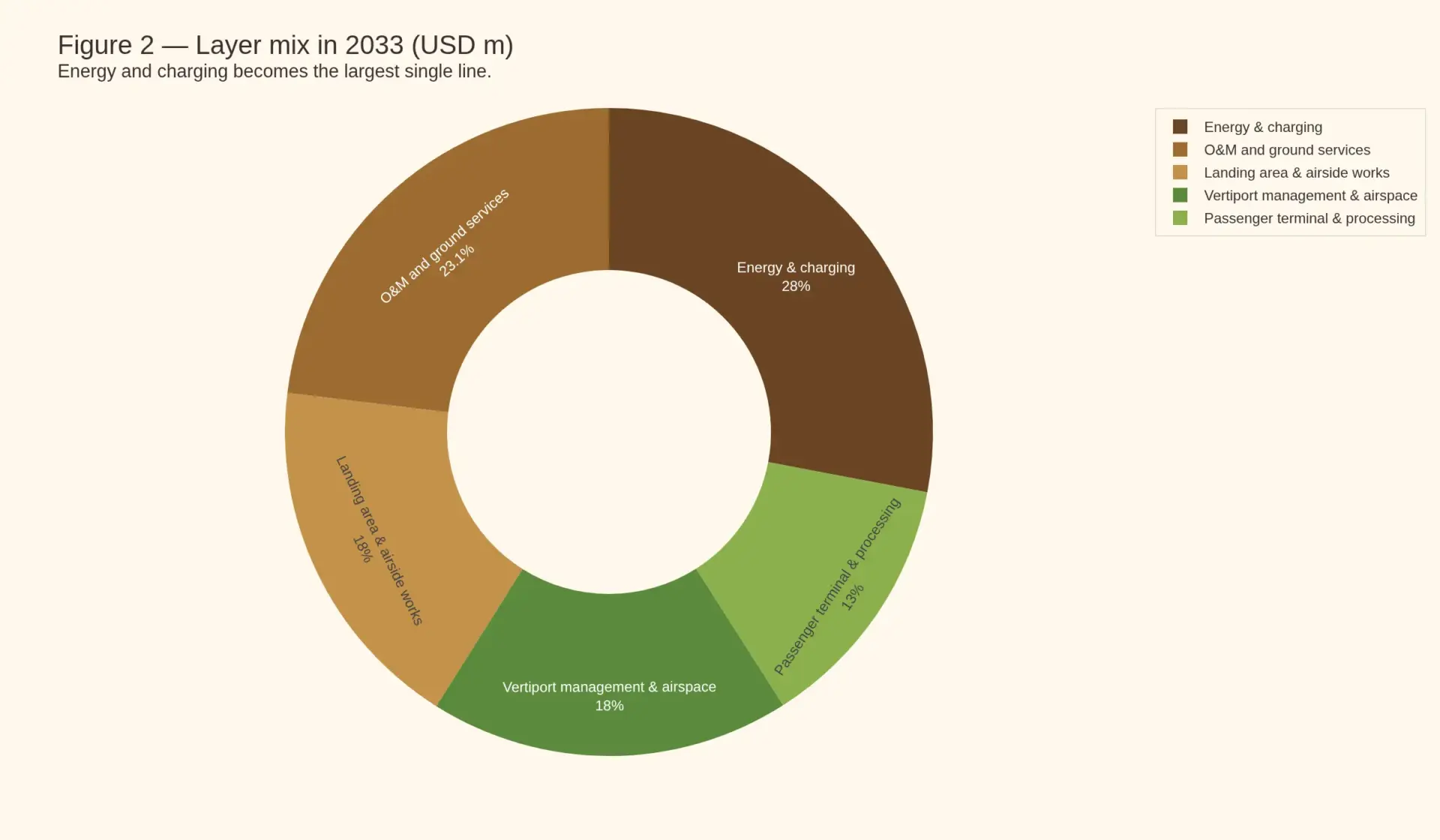
| Layer | 2025, USD m | 2025 share | 2033, USD m | 2033 share | CAGR | Share change |
|---|---|---|---|---|---|---|
| Energy and charging | 405 | 25.0% | 3,190 | 28.0% | 29.43% | +3.0 pts |
| Operations and ground services | 373 | 23.0% | 2,630 | 23.1% | 27.65% | +0.1 pts |
| Landing area and airside works | 372 | 23.0% | 2,050 | 18.0% | 23.78% | −5.0 pts |
| Vertiport management and airspace integration | 227 | 14.0% | 2,050 | 18.0% | 31.66% | +4.0 pts |
| Passenger terminal and processing | 243 | 15.0% | 1,480 | 13.0% | 25.34% | −2.0 pts |
| Total | 1,620 | 100% | 11,400 | 100% | 27.62% |
The fastest layer is the one you cannot see
Vertiport management and airspace integration grows at 31.66 per cent, the highest rate in the model, from USD 227 million to USD 2,050 million, and takes four points of share. This is the software and systems layer: the site's traffic sequencing, its interface to an unmanned traffic management service provider, its surveillance and communications, its billing and its data. It grows fastest for a structural reason rather than a technological one. A site cannot be certified without it, it does not scale with the size of the slab, and it is licensed per site rather than built per site. Once a jurisdiction decides that a vertiport must connect to a traffic-management environment, every site in that jurisdiction carries the cost of the connection.
The European trials show the shape of it. In February 2026, Aeroporti di Roma and UrbanV completed live flight trials at the Fiumicino vertiport as part of a SESAR 3 project, connecting three separate platforms — a common information service provider, a U-space service provider and a vertiport network management system — with ENAV, D-Flight, Leonardo, Unisphere, Techno Sky, Eurocontrol and SEA Milan among the partners. That is a five-system integration exercise at a single test site. Multiply it across 1,340 sites and the layer's growth rate stops looking aggressive.
The slowest layer is the one you can see
Landing area and airside works grows at 23.78 per cent, the lowest rate in the model, and falls from 23.0 to 18.0 per cent of value. Two things drive it. First, as section 3 set out, the regulator made the pad smaller and cheaper: the December 2024 revision of the FAA's vertiport guidance re-based landing-area geometry on the propulsion-unit diameter and reduced the required safety area. Second, most new sites are retrofits of surfaces that already exist — a rooftop, a car-park deck, an apron, a park. A market that retrofits does not buy as much slab as a market that builds.
There is an instructive parallel in this series. The parking occupancy sensing report found detection migrating from the road surface to the pole, so that one camera covered forty bays that had needed forty sensors, and the sensing line grew more slowly than the bay count. Here the slab behaves the same way: the physical element that defined the asset in the first generation of designs becomes a smaller share of the spend as the intelligence and the energy around it grow.
Energy and charging: the largest line by 2033
Energy and charging starts at USD 405 million, a quarter of the market, and ends at USD 3,190 million, 28.0 per cent of it, at 29.43 per cent. Three components sit inside that line: the service connection or on-site generation, the chargers themselves at 500 kilowatts to 1 megawatt each, and the storage and conditioning that lets a site draw an average load rather than a peak one. The storage component is the newest and the least understood. Schneider Electric's argument — size the battery to the peak and the connection to the average — turns a grid-queue problem into an equipment-purchase problem, which is a different supplier, a different lead time and a different margin.
One number puts the utilisation question in perspective. BETA Technologies reported 168 charging sites in 14 countries, more than 78,000 completed sessions and 1.46 gigawatt-hours delivered by the third quarter of 2026. That is 18.72 kilowatt-hours per session — a small top-up, not a full charge. The network is real, the throughput per site is early, and the installed capacity is running well ahead of the energy actually delivered through it. That is what a build-ahead-of-demand infrastructure layer looks like from the inside.
The middle layers are where the incumbents live
Passenger terminal and processing grows at 25.34 per cent and loses two points of share, because most pads have no terminal and most bases use a modular unit. Operations and ground services grows at 27.65 per cent and holds its share almost exactly, because it is a function of the installed base rather than of the build rate: as the site count compounds, so does the cost of keeping sites open.
These two layers are where conventional infrastructure and aviation-services companies enter the market. A terminal is a building, and building owners know how to build buildings. Ground services are staffing, fire cover, screening and turnaround, and fixed-base operators already do this work at 105 locations across North America. The layers where incumbency does not help are the two fastest-growing ones: no existing utility sells a vertiport connection as a product, and no existing air traffic service provider sells a per-site vertiport management licence.
What the split means for a supplier
Three commercial conclusions follow from the table, and they are the reason to read it rather than the growth rate.
Energy sells to every site regardless of which aircraft wins. A charger and a grid connection are aircraft-agnostic until you choose the interface, and the interface choice is the only place where the OEM exerts leverage. A supplier that can sell a convertible interface sells into the whole market.
Slab contractors compete on price in a market that is 67 per cent pads. The volume is in small, repeatable, cheap sites with planning risk and no design premium. That is a civil contractor's business, not an aviation prime's.
Software gets paid per site, forever. The management and airspace layer is the only one where revenue recurs without a rebuild, which is why it is the layer most likely to consolidate. When a jurisdiction mandates a connection to a U-space environment, the supplier of that connection has a renewal, not a project.
The curb and kerbside management report in this series made the same distinction between a collection layer that gets digitised and an allocation layer that gets decided. Here the equivalent is between the layer that gets poured and the layer that gets licensed. The poured layer grows 23.78 per cent. The licensed layer grows 31.66 per cent. Over eight years, that difference is the whole margin.
6. Regional Analysis
The regional split in this market is not a wealth map. It is a map of who has written a certificate, who has written a statute, and who already owns the landing surfaces. Those three variables explain almost all of the distribution below.
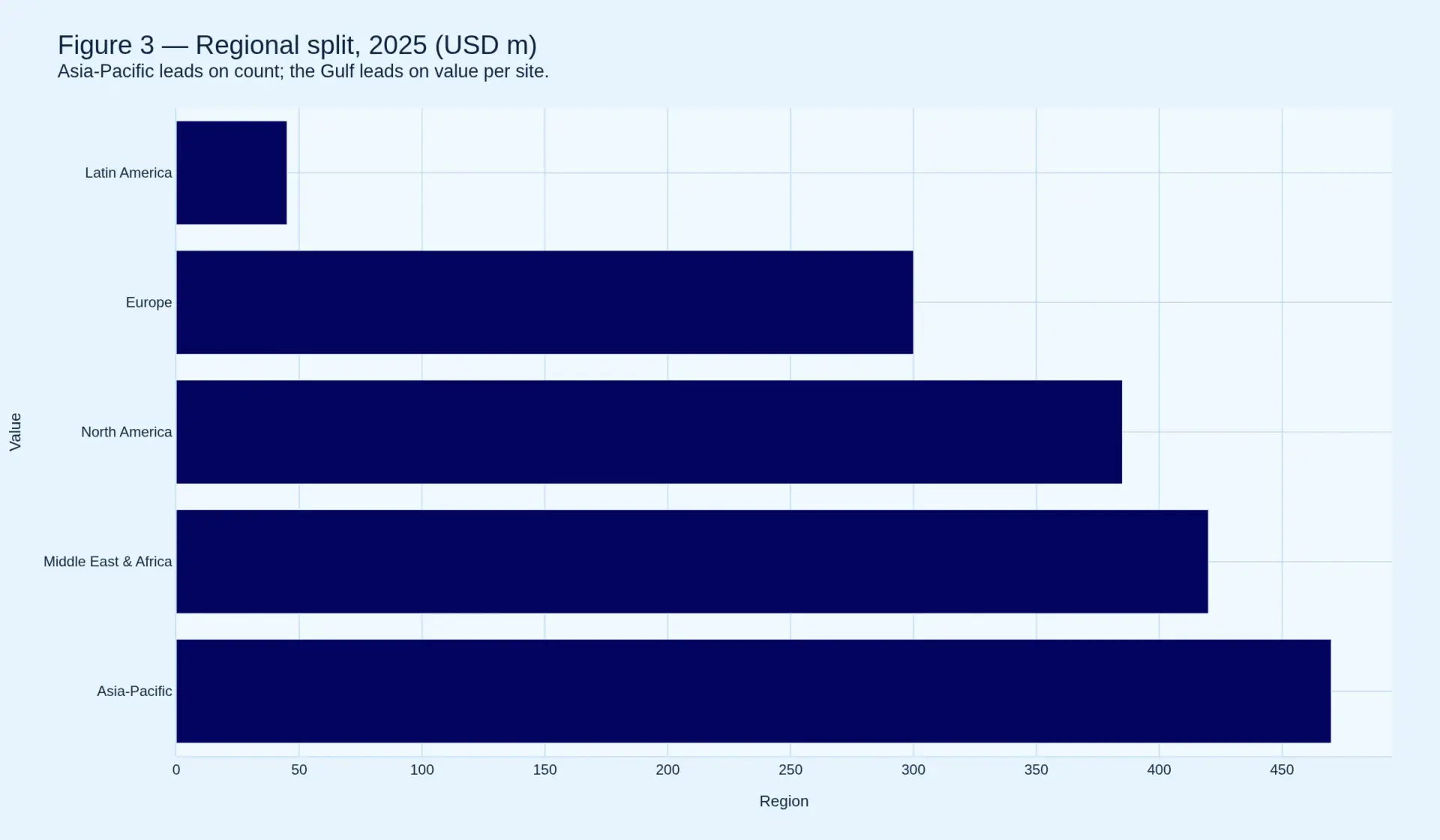
| Region | 2025 value, USD m | 2025 sites | Value per site, USD m | 2033 value, USD m | 2033 sites | CAGR | 2033 share |
|---|---|---|---|---|---|---|---|
| Asia-Pacific | 470 | 46 | 10.22 | 3,650 | 640 | 29.20% | 32.0% |
| Middle East & Africa | 420 | 12 | 35.00 | 3,020 | 165 | 27.97% | 26.5% |
| North America | 385 | 34 | 11.32 | 2,510 | 330 | 26.41% | 22.0% |
| Europe | 300 | 23 | 13.04 | 1,880 | 175 | 25.79% | 16.5% |
| Latin America | 45 | 3 | 15.00 | 340 | 30 | 28.76% | 3.0% |
| Total | 1,620 | 118 | 13.73 | 11,400 | 1,340 | 27.62% | 100% |
Asia-Pacific: the count leader, at a tenth of the ticket
Asia-Pacific carries 39 per cent of the world's sites in 2025 on 29 per cent of its value, at USD 10.22 million per site — the lowest in the model by a wide margin. That is not weakness. It is a different product.
China has built the only large population of operating sites in the world. EHang reported more than 40 eVTOL operation sites established by customers and partners across the country by the first quarter of 2026, with two air operator certificate holders running internal trial commercial operations since March 2025 and more than 3,000 safe flight missions completed. The company's own description of those sites is the clearest available taxonomy of the pad class: a hub-style dual-pad operating site in a Hefei city park, an urban integrated vertiport with an elevatable hangar in Shenzhen, a coastal logistics hub at a Zhuhai port, an inter-city aerial tours site in Guangzhou. These are tourism, logistics and demonstration assets at low capital cost, not airport-grade intermodal hubs.
Policy is the reason the count exists. China's amended Civil Aviation Law, adopted in December 2025 and in force from 1 July 2026, names the low-altitude economy in its airspace provisions and requires airspace division to take account of it. Elsewhere in the region the approach is more cautious and more structured: Korea's K-UAM Grand Challenge has been running since 2023 with commercial ambitions this decade; Japan has been the target of sustained subsidy and feasibility work, with Skyports reporting nine Japanese AAM subsidy project wins in 2026 across Oita, Mie and other prefectures; Skyports' portfolio also includes Jeju Island in Korea and the Gold Coast in Australia.
Our forecast assumes Asia-Pacific keeps the count lead and closes part of the value gap, reaching 640 sites and USD 3,650 million at 29.20 per cent — the fastest growth of any region. The value-per-site figure rises from USD 10.22 million to USD 5.70 million even so, because the marginal site keeps getting cheaper. That is the count market in its purest form.
Middle East and Africa: the value leader, on twelve sites
Twelve sites carry USD 420 million in 2025, which is USD 35.00 million each — three and a half times the global average. This is where the hub class lives, and it is where the only certified commercial vertiports in the world operate.
The Dubai International Airport vertiport reached technical completion in April 2026: 3,100 square metres over four floors, two dedicated take-off and landing areas, capacity for 170,000 passengers and 42,000 movements a year, direct access to the Emirates Metro Station and an integrated multi-storey car park. In November 2026 the Dubai Marina vertiport was completed and certified by the General Civil Aviation Authority under its CAR AGA Part VFI regulation, carrying the call sign VMR and creating the first permanent vertiport-to-vertiport route, to be flown by Joby under an exclusive six-year operating right. The remaining two nodes, Dubai Mall and Palm Jumeirah, are in development.
Abu Dhabi has a parallel programme: ten vertiports planned, with Zayed International and Al Bateen Executive confirmed as sites and Abu Dhabi Airports investing in and building them, alongside an investment framework with Archer that begins with at least two piloted aircraft introduced in partnership with Abu Dhabi Aviation and Etihad Aviation Training. Add Ras Al Khaimah's network agreement with Skyports, a Kuwaiti partnership between KNETCO and Skyports, and the region's distinctive regulatory posture — a hybrid framework that lets the same site handle conventional helicopters and electric aircraft — and the reason for the value-per-site premium is obvious. The state is the customer, the land is free at the point of use, and the certificate already exists.
We forecast USD 3,020 million by 2033 at 27.97 per cent, with value per site falling to USD 18.30 million as the network expands beyond flagship hubs into secondary cities. That remains six times the Asia-Pacific figure. Nothing in the region's pipeline suggests it will converge downward.
North America: the largest addressable base, the slowest certification
North America has 34 sites in 2025 and the largest retrofit base in the world: 5,712 heliports in the FAA's October 2026 data cycle. It also grows slowest of the four major regions at 26.41 per cent, and the two facts are connected.
There is no vertiport certificate in the United States. A vertiport is a type of heliport, governed by an advisory circular and, since December 2024, an engineering brief. That is workable for a retrofit and awkward for a purpose-built commercial hub, because the planning authority, the insurer and the lender all want to see a certificate category that does not exist. The FAA's answer has been procedural rather than regulatory: the eVTOL Integration Pilot Program, with eight selections across 26 states and operations beginning in summer 2026, is designed to generate the data that will support rules later. Its flagship site, eVTOL passenger operations at the Manhattan heliport, is a retrofit of an existing facility.
Private capital has filled the gap at the site level. Archer aligned with Atlantic Aviation in 2024 to electrify existing FBO locations across Los Angeles, Northern California, South Florida and the New York region, and in 2026 agreed a vertiport at L.A. LIVE with AEG ahead of the 2028 Games. BETA Technologies has built the only genuinely national charging network in the market — 168 sites across 14 countries by the third quarter of 2026 — and its management was explicit that these are not showcase installations but hospitals, regional airports and emergency-response staging areas. That is the American ground layer as it actually exists: utility infrastructure for missions that already pay, with the urban air taxi as an option on top.
Europe: writes the rulebook first, builds second
Europe publishes the most sophisticated vertiport design guidance in the world and grows slowest, at 25.79 per cent. EASA's prototype technical specifications arrived in March 2022 and remain, in the authority's own words, non-binding guidance pending a full rulemaking task that will introduce certification specifications and operator requirements. The UK Civil Aviation Authority consulted on vertiport design at existing aerodromes in 2024, published its response in July of that year, and scoped the proposal to visual flight rules by day and night, expressly excluding instrument flight rules and instrument meteorological conditions.
The infrastructure is nonetheless real and it is deliberately test-bed shaped. The Fiumicino vertiport outside Rome, about 5,500 square metres with a final approach and take-off area, parking, a 20 × 20 × 6 metre hangar and a battery charging area, was built to EASA's prototype specifications inside a regulatory sandbox approved by the Italian authority. UrbanV, established by Aeroporti di Roma with the airports of the Côte d'Azur, Venice and Bologna, has since taken that model to Korea Airports Corporation. Skyports operates heliports and vertiports at London, Bicester, Cergy-Pontoise and the VeGa site in Italy. Europe's problem is not capability; it is that a site built to guidance cannot be certified to a rule that does not yet exist, and that in dense cities with good rail the substitution case for a short air taxi hop is weaker than in Los Angeles or Dubai.
Latin America: small, and honestly so
Three sites and USD 45 million in 2025, growing to 30 sites and USD 340 million at 28.76 per cent. Latin America's value per site — USD 15.00 million in 2025 — is above the global average because the small number of programmes are airport-led rather than pad-led. We do not pretend to a granular view here. The regional figure is the least evidenced in this report and the one most likely to be revised as programmes in Brazil, Colombia and Mexico reach a permitting decision.
A caveat on this table
The regional split is the softest table in this report, and it says so rather than implying otherwise. Site counts by country are not published by anyone consistently; the classification of a demonstration pad as a site is a judgement; and disclosed capital costs per site are almost non-existent, which is why value per site is our build-up rather than a source's figure. What can be defended is the ranking and the direction of the value-per-site differential, which is large enough — 35.00 against 10.22 — to survive a material error in either count. Tightening the regional table would require a separate pass over disclosed contract values and municipal permitting records by city, not a rewrite of this chapter.
Table of Contents
Competitive Landscape
The credible field in this market is smaller than the number of companies that describe themselves as being in it. Count the organisations that have commissioned a site, hold or share an operating certificate for one, and can repeat the process in a second city, and the number is under ten globally. That is the competitive set that matters, and it is why this market is best described as fragmented at the asset level and concentrated at the capability level: thousands of landowners will own a pad, and a handful of firms will know how to licence one.
| Position | Who occupies it | What they sell | Source of advantage | Structural weakness |
|---|---|---|---|---|
| Pure-play developer and operator | Skyports Infrastructure, Ferrovial Vertiports, UrbanV, VPorts, Volatus Infrastructure, Urban-Air Port, Skyportz | Site development, consenting, operations | Regulatory know-how; network of sites; OEM relationships | Depends on an anchor operator it does not control |
| Airport and FBO incumbent | Atlantic Aviation, Groupe ADP, Aeroporti di Roma, Abu Dhabi Airports, Korea Airports Corporation, ORIX, Port Authority of New York and New Jersey | Land, intermodal access, existing certificates | Owns the ground and the passenger flow already | Slow capital cycles; competing internal priorities |
| Energy and charging supplier | Schneider Electric, BETA Technologies, Joby Aviation (GEACS), established electrical OEMs | Service connections, chargers, storage, conditioning | Aircraft-agnostic until the interface is chosen | Interface competition can strand installed equipment |
| Management and airspace systems | ENAV and D-Flight, Leonardo, Unisphere, Skygrid (a Wisk company), national air navigation service providers | Vertiport network management, U-space services, surveillance | Mandated connection; per-site licensing | Depends on a mandate that only some jurisdictions have written |
The pure-play developers: one operator with certified sites, several with pipelines
Skyports Infrastructure is the only pure-play developer that can currently point to certified commercial sites. Its own portfolio page lists seven heliports and vertiports across ten countries, including the Dubai network, Ras Al Khaimah, Abu Dhabi, the London Heliport, Bicester, Cergy-Pontoise in France, the VeGa site in Italy, a downtown skyport in New York, a living lab with Joby in California, South Florida, Jeju Island in Korea, Japan and the Gold Coast in Australia. That breadth is the asset. The Dubai International Airport vertiport reached technical completion in April 2026 and the Dubai Marina vertiport was certified by the UAE General Civil Aviation Authority in November 2026 under CAR AGA Part VFI, creating the first permanent vertiport-to-vertiport route.
Ferrovial brings the opposite advantage: a concessions and infrastructure balance sheet, a construction arm, and a portfolio of toll roads and airports that already price regulated assets. Its vertiport subsidiary has identified more than twenty sites across the United Kingdom and the United States. It is the only participant in the market that could finance a network the way a motorway is financed, which matters in a market where the first 100 sites will not be cash-generative.
UrbanV is the most instructive model in the market because it is airport-led rather than developer-led. Established by Aeroporti di Roma with the airports of the Côte d’Azur, Venice and Bologna, it built Italy’s first vertiport at Fiumicino — about 5,500 square metres, with a final approach and take-off area, parking positions, a 20 × 20 × 6 metre hangar and a battery charging area, designed to EASA’s prototype specifications inside a sandbox approved by the Italian civil aviation authority. It has since taken that model to Korea Airports Corporation. When your shareholder already holds the land, the planning authority relationship and the passenger, the cost of the first site falls sharply.
The rest of the position is thinner than the announcements suggest. VPorts, Volatus Infrastructure, Urban-Air Port and Skyportz all have designs, partnerships and, in some cases, funded first sites, but none has yet demonstrated the repeat cycle — consent, build, certify, operate, replicate — that the three above have demonstrated at least once.
The incumbents: they own the thing that is hardest to buy
The second position is the one that will own most of the eventual asset base, because its members already own the two inputs that cannot be manufactured: land in the right place, and an operating organisation that a regulator already knows.
Atlantic Aviation operates more than 105 fixed-base operator locations in North America. It signed a memorandum with Archer in 2024 to electrify existing locations across Los Angeles, Northern California, South Florida and the New York region, using BETA’s interoperable charging systems. Nothing about that arrangement requires a new building. It is a retrofit programme across a permitted estate, which is the cheapest possible route to a national network.
The airport operators behave the same way with more capital. Groupe ADP and Aeroporti di Roma are both equity holders in vertiport developers as well as landowners. Abu Dhabi Airports is investing in and building a ten-site network outright. The Port Authority of New York and New Jersey is running eVTOL passenger operations at the Manhattan heliport as one of twelve operational concepts in the federal pilot programme. Korea Airports Corporation has partnered with UrbanV. In Japan, ORIX, Kansai Electric Power and Aero Facility operated the vertiports used for demonstration flights at the 2025 World Expo.
The weakness of this position is speed. An airport operator’s capital committee competes with runway resurfacing, and a heliport manager’s incentive is to keep the helicopter business running rather than to add a charging interface for an aircraft that will not arrive for two years. That is the window the pure-play developers are exploiting, and it is a narrow one.
Energy and charging: the position with the real leverage
Schneider Electric is the clearest example of a company entering from outside aviation and instantly owning the critical path. Its assessment — 5 to 10 megawatts for a multi-aircraft site, chargers at 500 kilowatts to 1 megawatt, grid connections taking one to four years, transformers 18 to 24 months — is not a market forecast. It is a description of what its own project teams are finding, and it reframes the buyer’s problem from construction to electrical capacity.
BETA Technologies has built the largest charging footprint in the market — 168 sites across 14 countries at the third quarter of 2026, with more than 78,000 sessions and 1.46 gigawatt-hours delivered — on a combined-charging-system interface, and has been explicit that these are hospital, regional-airport and emergency-response installations rather than urban showcases. Joby Aviation built the opposite: a proprietary interface, released freely as a specification in November 2023, with integrated battery conditioning and simultaneous charging of multiple packs, on the argument that a repurposed automotive standard would fragment the industry the way automotive charging fragmented.
Both arguments are coherent, and that is the problem for a site owner. The first commercial vertiport in the world is equipped with Joby’s system because Joby is the anchor operator there. A site that chooses one interface and loses its anchor tenant has bought an expensive obstacle.
Software: small today, and the only layer with a renewal
The fourth position barely exists as a commercial category yet, which is why it grows fastest in our model. The European trials at Fiumicino in February 2026 connected a common information service provider, a U-space service provider and a vertiport network management system, with ENAV, D-Flight, Leonardo, Unisphere, Techno Sky and Eurocontrol among the participants. In the United States, Boeing’s Wisk subsidiary moved Skygrid, an autonomous-flight and airspace-management provider, into its own ownership in 2025. These are the suppliers who will bill every site, every year, once a jurisdiction mandates the connection.
What the competitive structure actually is
No participant in this market holds a durable advantage on its own. The landowner has the ground and no operating capability. The developer has the capability and no balance sheet to match an infrastructure cycle. The energy supplier has the critical path and no relationship with the regulator. The software supplier has the recurring revenue and no mandate.
The advantage sits in the combination, and the Dubai structure is the template: a transport authority governs and grants, a developer designs, builds, owns and operates, and an aircraft manufacturer holds an exclusive operating right and supplies the aircraft. Each party carries the risk it can price. Nobody carries utilisation risk alone. Where that three-way structure exists, sites get certified. Where one party tries to hold all three, the site stalls — which is the pattern behind most of the announcements in this market that have not yet produced a building.
Consolidation is already running along those seams. ACS Group, through its Iridium concessions business, became the largest shareholder in Skyports in 2024. Volocopter, insolvent at the end of 2024, was acquired by a Chinese group. Boeing absorbed Skygrid. The next wave will be airport operators buying developers, because the cheapest way for an incumbent to acquire consenting capability is to buy the team that has already certified a site.
Value Chain
The value chain in this market is unusual in one respect: the party that owns the asset is rarely the party that determines whether it earns anything. A vertiport’s revenue is a function of movements, movements are a function of aircraft and fares, and neither belongs to the site owner. Everything about the chain’s structure follows from that separation.
| Stage | Function | Typical holder | Revenue form | Risk carried |
|---|---|---|---|---|
| Land and access | Freehold or lease, intermodal connection | Airport, transit authority, property owner | Ground rent, often indexed | Almost none; first in the queue |
| Consent and certification | Planning consent, aerodrome-type certificate, airspace integration | Developer, sometimes the transport authority | Embedded in development margin | Binary outcome, sunk cost if refused |
| Design and construction | Slab, building, systems installation | EPC contractor | Fixed price, progress payments | Execution only; paid before operations |
| Energy and charging | Service connection, chargers, storage, conditioning | Utility and electrical OEM | Equipment sale, service contract, sometimes energy | Interface and technology risk |
| Management and airspace | Sequencing, U-space connection, surveillance, billing | Software and air navigation providers | Per-site licence, recurring | Low; mandated in some jurisdictions |
| Operations | Staffing, fire cover, screening, turnaround, maintenance | Developer-operator or FBO | Fee per movement or per passenger | Utilisation risk |
| Demand | Aircraft, pilots, fares, marketing | Airline or eVTOL operator | Seat revenue | All of the commercial risk |
The inversion at the centre of the chain
In a conventional transport asset the operator controls capacity and therefore revenue. Here the site controls capacity in a legal sense and the aircraft operator controls it in an economic sense, because a pad with no aircraft is a car park with unusual markings. That inversion explains three features of this market that otherwise look irrational.
Why developers accept exclusive operating rights. A six-year exclusive right to operate from a network, of the kind Joby holds in Dubai, looks like a concession the site owner should not grant. In practice it is the only way to underwrite the site: an exclusive anchor is what makes a movement forecast bankable. The site owner trades optionality for certainty, and in a market with three credible aircraft and thousands of potential sites, certainty is worth more.
Why the state keeps appearing in the middle of the chain. Where the operator cannot underwrite the site and the developer cannot carry the delay, a transport authority becomes the party of last resort. Dubai’s Roads and Transport Authority is not a landlord in the ordinary sense; it is the guarantor of the network’s coherence. Abu Dhabi Airports plays the same role with capital. China’s provincial governments play it by designating low-altitude economy zones.
Why consortium structures beat vertical integration. A developer that buys an aircraft manufacturer takes on certification risk it cannot manage. An aircraft manufacturer that builds its own vertiports takes on consenting risk in dozens of jurisdictions. The Fiumicino model — airport authority, developer, and a technology partner inside a regulator-approved sandbox — is slow, but it is the only structure that has repeatedly produced a working site.
Where the margin sits
Read the chain in order and the margin pools are visible. Land rent is first in the queue and takes a fixed share regardless of utilisation. Construction is paid on completion. Energy equipment is paid on delivery. Software is licensed per site. Operations are paid per movement and therefore carry the risk. The residual — what is left after land, debt service, staff and the operator’s share — is thin, variable, and sits with whoever owns the asset.
That is why the two fastest-growing layers in section 5 are also the two with the least risk. A charger supplier and a vertiport management system supplier get paid whether or not the aircraft arrive, and both get paid again when a site is upgraded. The slab contractor gets paid once. The asset owner gets paid last, and only if the network works.
The handover problem, restated
There is a direct parallel in the airport baggage handling report in this series. There, 41 per cent of mishandled bags were lost at transfer — the point where one system hands a bag to another, frequently across two vendors and two contracts — and the market was paid to move bags and paid comparatively little to know where they went. Here the equivalent seam is the passenger handover between an aircraft operator’s booking system and a vertiport’s processing system. The site is contracted to process a passenger it does not sell to, on a schedule it does not set, with a security regime it may not control and a turnaround time it cannot enforce because the aircraft’s charging is the operator’s decision.
The better sites are already closing that seam contractually rather than technically. The Dubai International Airport vertiport integrates booking through the operator’s app, automated digital check-in and a designed passenger path from kerb to seat, because the site operator, the transport authority and the aircraft operator agreed the process before the building opened. That agreement, not the building, is the asset. It is also the part that is hardest to copy, which is why the sites that work are the ones where all three parties sat in the same room at design stage.
The chain in one sentence
The value chain runs from land to licence to slab to power to software to operations to demand, and the further along it you go the more risk you carry and the less you are paid for it — which is why the capital in this market is concentrating at the power and software end, and why the asset owners are increasingly public bodies and infrastructure funds rather than venture capital.
Investment Activity
Capital is entering this market from four directions, and they are not priced the same way. Infrastructure equity is buying developers. Airport balance sheets are buying their own networks. Public programmes are buying integration work. And growth capital is buying charging and software. The mismatch between those four and the asset class they are funding is the central investment fact of the sector.
| Event | Date | Capital and form | What it says |
|---|---|---|---|
| ACS Group, via Iridium, becomes largest shareholder in Skyports; Groupe ADP increases its position | 2024 | Equity, in excess of USD 110m Series C | Infrastructure money is buying consenting capability, not sites |
| Skyports Series B | 2022 | USD 23m equity | Development capital for pre-revenue site build |
| Abu Dhabi Airports commits to build and invest in a ten-vertiport network | 2025 | Corporate capital, undisclosed | The airport owns the land, so it owns the return |
| BETA Technologies lists and scales charging to 168 sites in 14 countries | 2026 | Public equity; USD 4bn aircraft backlog | Charging is being financed as part of an aircraft business |
| Archer and AEG agree a vertiport at L.A. LIVE | 2026 | Private development agreement | Events create the permitting deadline that capital cannot |
| Archer and Atlantic Aviation electrify existing FBO locations | 2024 | Memorandum, retrofit capex | The cheapest capacity is a site that already exists |
| SESAR 3 EUREKA project completes live trials at Fiumicino | 2026 | Public research funding | Europe is funding integration, not buildings |
The Skyports round is the tell
In April 2024 Skyports raised more than USD 110 million in a Series C led by ACS Group, the Spanish infrastructure and construction group, through its Iridium concessions business, with Groupe ADP increasing its existing position. ACS reported revenue of USD 39 billion in 2023; Iridium’s chief executive took the chair. That is not a venture round. It is an infrastructure investor buying a platform, and it tells you what the buyer thinks the scarce asset is. It is not the pad. It is the team that can get a site certified in ten countries and the relationship with the transport authority that grants the certificate.
Read alongside the 2022 Series B of USD 23 million, the pattern is a company that needed venture money to prove a site and infrastructure money to replicate it. That is the financing path the whole developer layer will have to follow, and most of its members have not yet closed the first step.
Public money is funding the unbankable part
The FAA’s pilot programme does not pay for vertiports. It designates places, integrates procedures and collects data, and leaves the capital to the site owner. Europe’s SESAR programme funds the integration work — the Fiumicino trials that connected three platforms and a dozen partners were a research project, not a commercial one. China’s provinces designate zones. The UAE’s authority legislates the certificate category.
In each case the public sector is funding the part of the value chain that no private party can monetise: the rulebook, the integration, the data. That is rational and it is also a signal. When the state has to fund the interoperability layer, the interoperability layer is not yet a market.
Where the aircraft money went, and why it matters to a site owner
The capital intensity on the aircraft side dwarfs the ground side, and it has been volatile. Archer ended the first quarter of 2025 with USD 1.03 billion in cash and a burn rate of about USD 124 million a quarter; Joby ended the same quarter with USD 813 million and expected to spend USD 500 to 540 million across the year. Against that, a single vertiport is a small bet — which is precisely why developers struggle to raise: the round is too small for an infrastructure fund and too large for a venture fund, and the return depends on an aircraft operator’s certification timeline that the investor cannot influence.
The consequence is a barbell. Money is plentiful at the two ends — aircraft development and individual site development with a committed anchor — and scarce in the middle, where a developer wants to fund a pipeline of ten sites before any of them has an operator.
What would make this bankable
Three things, in order of impact.
A certificate category in the two largest markets. The United States has no vertiport certificate and the European Union’s rules are still a rulemaking task. The moment either creates a certifiable category with a published specification, a site becomes an asset a lender can underwrite, because the regulatory risk moves from unknown to priced. The UAE has already demonstrated the effect: two certified sites inside eighteen months of the regulation being written.
A standard interface. The split between Joby’s proprietary specification and the combined-charging-system approach used by BETA and adopted at Atlantic’s locations is a real barrier to lending. A bank financing a charger wants to know the asset can serve more than one aircraft type. Until that is settled, the charging layer will be financed by the equipment vendor or the OEM, not by project debt.
A visible utilisation curve. Dubai will provide the first real one. A network designed for 42,000 movements a year, launched with a single operator and a small fleet, will publish — through the operator’s own reporting — the ratio of design capacity to actual movements. That number, once it exists, will reprice every site in the world, in one direction or the other.
The honest summary for an investor
The ground layer is not where the risk is highest in this industry, but it is where the return is most capped. A site earns a fee per movement and a share of a concession; it does not capture the upside of a successful aircraft programme, and it carries the downside of a failed one through stranded capital. That is why the sensible structures being built today put land with an infrastructure owner, development with a specialist, and demand with an operator who has committed aircraft — and why the sites that skip one of those three legs are the ones still waiting for a building permit.
Technology & Innovation
Three technology questions decide the economics of a vertiport, and none of them is about the aircraft. They are how fast a battery can be turned around, how much electrical capacity the site can obtain and buffer, and whether the site’s traffic can be sequenced without a controller looking out of a window.
Charging: one connector, two philosophies
The industry has a de facto split, and it is not a standards-body argument — it is a commercial one with a technical vocabulary.
Joby Aviation released the specifications for its Global Electric Aviation Charging System freely in November 2023, on the explicit argument that the automotive approach had failed: a push toward a lowest-common-denominator interface had, in the company’s words, failed the market test. Its system builds on automotive standards but adds the things an aircraft needs — battery conditioning during charge, secure high-speed data offload to meet safety and cybersecurity expectations, and the ability to charge multiple independent battery packs simultaneously — with the claimed benefit of a lower certification burden. It is fitted at the first commercial vertiport in the world, at Dubai International Airport.
BETA Technologies took the interoperable route. Its UL-certified Charge Cube is combined-charging-system compliant, accepts multiple payment methods including plug-and-charge, delivers a charge in fifty minutes or less, and has been deployed at 168 sites across 14 countries, with more than 78,000 sessions and 1.46 gigawatt-hours delivered as of the third quarter of 2026. Atlantic Aviation’s agreement with Archer explicitly planned to use BETA’s chargers across existing FBO locations.
For a site owner the choice is not technical. A proprietary interface locks the site to one aircraft family and secures the deepest integration with that operator. An interoperable interface widens the addressable tenant list and weakens the site’s negotiating position with any single one. Neither is wrong, and both are being built this year. What is wrong is treating the decision as reversible: retrofitting a charging interface means new switchgear, new conditioning, new certification evidence and a closure period.
Power: the site as a small utility
The most important piece of equipment at a vertiport may be a battery that never leaves the ground. The argument, set out by Schneider Electric and consistent with the National Renewable Energy Laboratory’s finding that a vertiport is not an everyday load, is that sizing a grid connection to the simultaneous peak of four to six aircraft is both slow and expensive, whereas sizing it to the average and buffering the peaks with on-site storage is faster and, at the margin, cheaper.
This turns the site into a small microgrid with an aviation licence attached, and it imports a supply chain that has nothing to do with aviation: transformers with 18 to 24 month lead times, medium-voltage switchgear, battery racks, and a control system that must decide, in milliseconds, whether the next megawatt comes from the grid or from the rack. Schneider has already built a 12-megawatt microgrid at the New Terminal One project at John F. Kennedy International Airport, which is the scale of electrical engineering a hub vertiport now requires.
The design consequence is that the electrical room is no longer a plant room. It is a revenue-determining asset, because every minute an aircraft spends charging is a minute it is not earning, and the operator’s stated target is a fifteen to thirty minute turnaround. That target is an electrical specification before it is an operational one.
The aerodynamics of the slab
Downwash and outwash are the least glamorous and most litigated technical subject in this market, because they determine how close a vertiport can be to anything else. The FAA’s December 2024 revision added a downwash and outwash caution area to the design guidance, citing its own Technical Center’s survey work on aircraft of 7,000 pounds and under. That addition has a commercial consequence: it reserves ground that would otherwise be lettable, and it is the technical reason rooftop and car-park sites have a hard limit on how much of the deck can be used.
The geometry change matters as much. By re-basing the landing area on the circle enclosing the propulsion units rather than the whole airframe, the revision reduced the required footprint for aircraft whose rotors are inboard of the airframe extremities. Designers now optimise the propulsion layout for the site as well as for the flight envelope, which is a subtle but real coupling between aircraft design and real-estate yield.
Site formats: the innovation is in the container, not the concrete
The pad class is where the format innovation is happening, and the Chinese portfolio is the best evidence. EHang’s operating sites include a hub-style dual-pad installation in a Hefei city park, an urban integrated vertiport in Shenzhen’s Luohu district with an elevatable hangar, a coastal logistics hub at a Zhuhai port and an inter-city aerial tours site in Guangzhou. An elevatable hangar is a specific answer to a specific problem: it stores the aircraft below deck and lifts it to the pad, which preserves the ground-level use of the site — retail, parking and public realm — while keeping the aviation function above it.
The European testbeds answer a different question. The Fiumicino vertiport is about 5,500 square metres with a final approach and take-off area, parking, a covered hangar of 20 × 20 × 6 metres, offices, a warehouse and a battery charging area, designed to test turnaround and charging technologies rather than to move passengers at scale. A testbed and a commercial hub are different products, and conflating them is the most common error in the public discussion of this market.
Systems: the integration is the hard part
A vertiport must hand an aircraft to an airspace environment and take it back. In Europe that means connecting to a U-space service provider and a common information service provider; the Fiumicino trials in February 2026 demonstrated exactly that chain, linking a common information service, a U-space service provider and a vertiport network management system in live flight. In the United States the equivalent function is being defined through the pilot programme rather than a mandated architecture.
What this looks like on site is unglamorous: a surveillance picture, a scheduling engine, a data link to the aircraft and the operator, and a billing record per movement. What it costs is a per-site licence, an integration project and a recurring connectivity charge. What it decides is whether the site can operate at design capacity, because a vertiport that cannot sequence arrivals without a human on a radio is capped at the throughput of that human.
The technology that is not there yet
Two gaps deserve naming. The first is instrument operations. The UK Civil Aviation Authority’s 2024 design proposal is explicitly limited to visual flight rules by day and night, and says the authority does not yet hold the validated VTOL performance data to do more. That is not a British peculiarity; it is a statement about the state of the evidence. Until instrument procedures and the associated site design standards exist, every vertiport in the world carries a weather-derated capacity, and no amount of charging innovation fixes it.
The second is autonomous ground movement. Air taxi economics assume an aircraft that lands, charges, boards and departs with minimal human intervention on the apron. The Chinese operators are furthest along this path because their aircraft are unmanned by design, and their regulatory framework has evolved around remote pilot training rather than around converting helicopter practice. Elsewhere, the apron will be staffed for longer than the business models assume.
Market Risk
The risks in this market are unusually legible. They are not unknown-unknowns; they are five specific things that can each be observed and, in most cases, dated. What makes them dangerous is that they compound: a grid delay pushes a site’s opening, a delayed opening weakens the anchor operator’s route case, a weaker route case reduces the aircraft allocated to the city, and the site that was built for 42,000 movements a year operates at a fraction of that.
| Risk | Likelihood | Impact on the ground layer | Indicator to watch |
|---|---|---|---|
| Aircraft production rate below the site build rate | High | Utilisation shortfall across 2027–2030; site revenue well below design capacity | Delivered aircraft per quarter against the 48-a-year target for 2027 |
| Grid connection and transformer lead times | High | 12–48 month delay on energisation; site complete but not operable | Utility queue position at each announced site; whether storage is specified at design stage |
| Rule-making delay in the US and EU | Medium–High | No certifiable site category; capital stays on the sidelines | EASA RMT.0230 output; any FAA move beyond guidance to a certificate category |
| Anchor-operator failure or consolidation | Medium | Site designed around an aircraft that never arrives; stranded charging interface | Cash runway and certification milestones at each OEM; type certificate issuance |
| Charging-interface lock-in | High | One-tenant site; retrofit cost on any change of operator | Interface specified in each new site’s procurement documents |
| Weather-derated capacity | Certain in the near term | VFR-only operation caps annual movements at every site outside the UAE | Publication of instrument procedures for any vertiport |
| Community and noise objection | Medium | Site delay or reduced operating hours; rooftop sites most exposed | Planning decisions at urban sites; operating-hour conditions in consents |
| Demand at the fare required | Medium | Movements below forecast; concession revenue short of debt service | First published fares and load factors once commercial service begins |
1. The fleet is the throttle, and the target is modest
Skyports’ own infrastructure director identified this in April 2026, unprompted: infrastructure and aircraft development were coming on well, but the rate of aircraft production was a potential medium-term barrier, because initial production is at a relatively low rate, and if markets accelerate there may not be enough aircraft to service the routes. Joby was targeting 48 aircraft a year by the end of 2027.
Put that against the site count. One thousand three hundred and forty sites by 2033 implies an installed base that no manufacturer’s current plan supplies. Even at three aircraft per site — a cautious assumption for a network that needs redundancy and spares — 1,340 sites require roughly 4,000 aircraft. At 48 a year, that is more than eighty years of production. The number is absurd on its face, which is the point: the site count in this model is not a fleet plan, and any site that assumes it will be served early in its life is making an assumption the manufacturers cannot currently support.
2. Value per site is falling, and that is a margin risk
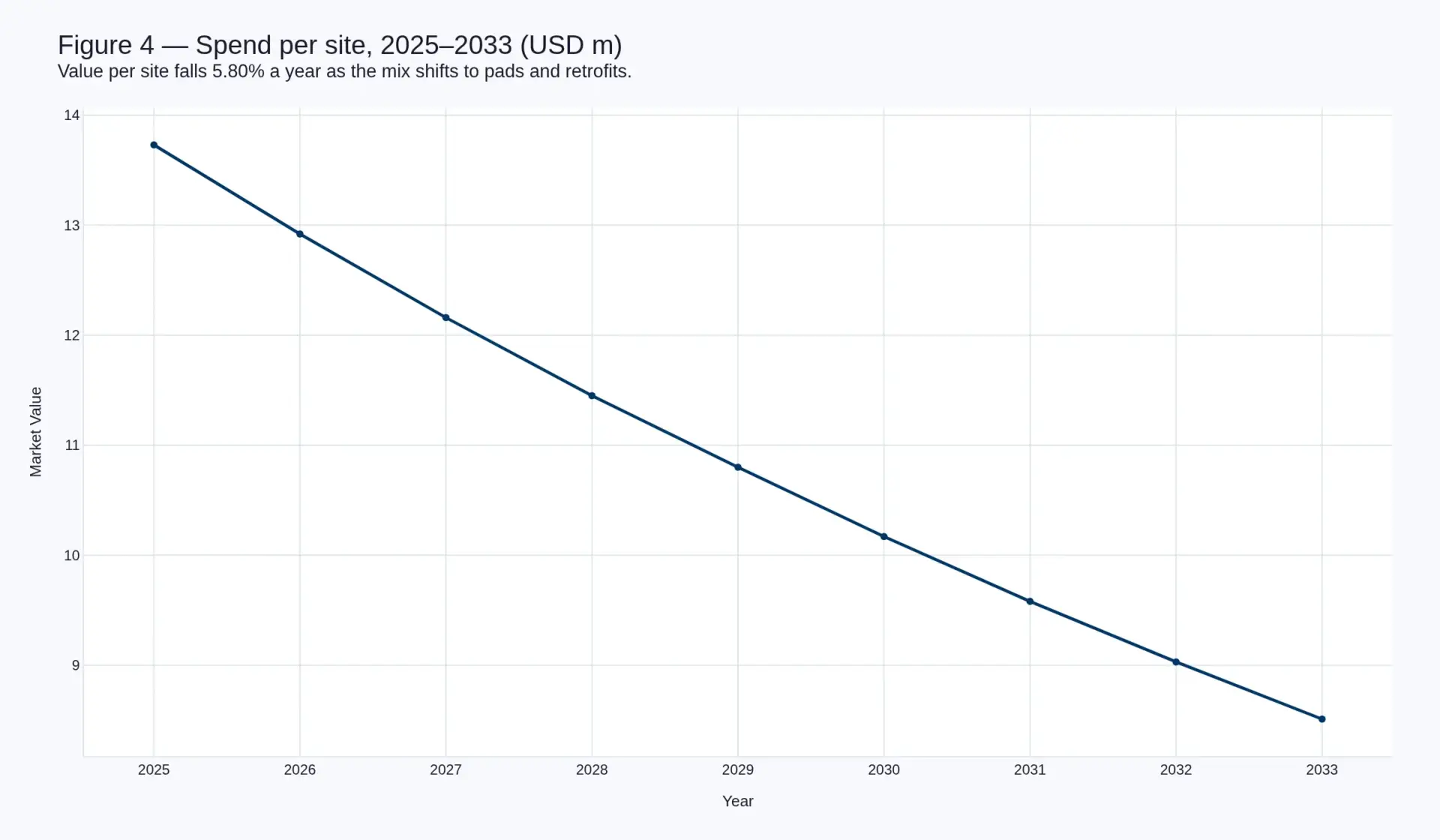
A developer with a pipeline of hubs is exposed to a market that is increasingly made of pads. The revenue per project falls, the number of projects rises, and the fixed cost of a consenting and design organisation is spread over smaller tickets. That is a viable business — it is the business civil contractors are in — but it is not the business most of the announced pipelines were priced for. The firms that will do well are the ones that industrialise the pad: a standard design, a standard electrical package, a standard consenting file, and a repeatable build.
3. The regulatory asymmetry cuts both ways
Regulatory delay is the most-discussed risk and the least likely to be fatal, because it is visible. The harder version is regulatory success in the wrong order. If the United States creates a vertiport certificate before there is a fleet, it will certify a wave of sites whose revenue cannot support them; if Europe’s rulemaking produces a specification that is more demanding than the aircraft can meet, it will certify none. The UAE’s advantage is that it wrote the rule for a specific aircraft and a specific network, in that order.
4. Stranded equipment is a quiet loss
The charging interface risk rarely appears on a risk register because it is buried in an equipment schedule. It is nevertheless the most common way for a site to lose value without anyone making a visible mistake. A site that installs a proprietary system for its anchor operator is a one-tenant asset with a financed asset base; a site that installs an interoperable system loses some integration depth but keeps its tenant list open. The industry has not converged, and both approaches are being installed at commercial sites this year.
5. The demand risk that nobody can model
Dubai’s Roads and Transport Authority has said fares are not yet decided, will initially be cheaper than helicopter rates, and are intended eventually to approach ride-hailing equivalence after several years of scale and cost reduction. That is an honest statement and it contains the whole demand risk: the product is currently priced as a premium shuttle, and the forecast in this report assumes it becomes something else.
What would falsify the forecast quickly is a published fare and a published load factor. If a ten-minute city pair prices at a level that attracts a few thousand passengers a year rather than a hundred thousand, the site economics do not collapse — sites are cheap to operate relative to airports — but the concession revenue does, and the tenth site in a network becomes much harder to finance than the first.
What is not, in our view, a material risk
Two commonly cited risks we weight lower than the market does. The first is technology readiness of the aircraft: the certification programmes are far enough advanced, with a final-stage type certification campaign running and a market-survey certificate already issued, that a complete failure of the aircraft layer is now unlikely. The second is public acceptance of noise: the aircraft are materially quieter than helicopters, and the sites being built in Dubai and Abu Dhabi sit in dense residential and leisure districts without generating the objection that a heliport would.
The risk that deserves more weight than it gets is simpler. This is an infrastructure market whose customers are start-ups. Its schedule is set by other companies’ funding rounds, and no amount of good site design changes that.
Regulatory Landscape
Five jurisdictions have now taken a position on what a vertiport is, and the positions are so different that the market’s geography follows them rather than following demand. The table below is the shortest accurate summary we can give of the current state.
| Jurisdiction | Instrument | Status | What it covers | Commercial consequence |
|---|---|---|---|---|
| United Arab Emirates | GCAA CAR AGA Part VFI; hybrid vertiport framework agreed with the GCAA | In force; two sites certified in 2026 | Certification of vertiports for commercial eVTOL operations; sites may also handle conventional helicopters | The only market where a purpose-built commercial vertiport can be certified today |
| United States | AC 150/5390-2D with Engineering Brief 105A (27 December 2024) | Guidance; no vertiport certificate category | Design standards for a vertiport treated as a type of heliport | Buildable and operable via existing heliport approvals; hard to finance as a new asset class |
| European Union | PTS-VPT-DSN prototype technical specifications (March 2022); rulemaking task RMT.0230 | Non-binding guidance; full rules pending | VFR design of vertiports for manned VTOL aircraft in the enhanced category | Member states may use it nationally; no harmonised certificate yet |
| United Kingdom | CAA consultation and response on vertiport design at existing aerodromes (2024) | Design proposals feeding CAP 168 and UK Reg (EU) 139/2014 | VFR day and night only; expressly excludes IFR and IMC | Retrofit-friendly, capacity-capped, awaiting performance data |
| China | Amended Civil Aviation Law (adopted 27 December 2025, in force 1 July 2026); CAAC air operator certification | In force; trial commercial operations under two operator certificates | Airspace division must consider the low-altitude economy; operator, type and production certification paths | The largest operating site population, at low capital cost per site |
| International (ICAO) | Annex 14 Volume II (Heliports); Doc 9261 Heliport Manual | No dedicated vertiport annex | Heliport standards, used as the basis for EASA’s prototype specifications | National divergence is the default until an annex exists |
The United States: guidance without a category
The FAA’s Engineering Brief 105A, issued on 27 December 2024, is a revision of the September 2022 original and it is guidance, not a rule. It supplements the heliport design advisory circular and treats a vertiport as a type of heliport serving aircraft with three or more propulsors, distinguished by a VTL marking on the touchdown and lift-off area. It adds parking positions sized for air or hover taxiing, re-bases landing-area geometry on the propulsion-unit diameter, reduces the safety area, and creates a downwash and outwash caution area with reference to the FAA Technical Center’s survey data.
That is a workable design standard and an incomplete regulatory product. A developer can build to it; what a developer cannot do is obtain a vertiport certificate, because the category does not exist. The FAA’s chosen route is empirical. Its Advanced Air Mobility Implementation Plan describes Innovate28 as culminating in integrated operations between multiple origins and destinations at one or more locations by 2028, and its March 2026 pilot programme selected eight projects across 26 states to generate operating data from summer 2026. The plan itself expects initial operations to run primarily from existing airports and heliports, with purpose-built vertiports unlikely in that window.
Read together, those two documents say something clear: the United States has decided to prove the operation before it writes the rule, and it intends to use its own heliport estate as the proving ground. That favours retrofits, favours FBOs, and delays the purpose-built hub.
Europe: two stages, and the second one is late
EASA’s prototype technical specifications were the first detailed vertiport design guidance published anywhere, in March 2022, and they remain guidance. The document is explicit about the plan: a first stage of non-regulatory material for VFR vertiports serving manned VTOL aircraft certified in the enhanced category, and a second stage, under rulemaking task RMT.0230, introducing a full set of vertiport rules including authority, operator and operation requirements together with certification specifications and guidance material. Its most distinctive technical contribution is the funnel-shaped obstacle-free volume above the site, designed around the capability of the aircraft to land steeply rather than around helicopter approach angles.
The gap between stage one and stage two is the commercial problem. A member state may adopt the prototype specifications nationally, and Italy effectively did so for the Fiumicino testbed inside a regulatory sandbox; but a site designed to guidance cannot be certified to a rule that does not exist. That is why Europe publishes the best documentation in the world and grows slowest in this report’s forecast.
The United Kingdom is running a parallel process with a narrower scope. The Civil Aviation Authority’s consultation on vertiport design at existing aerodromes, opened in January 2024 and answered in July, proposed standards for VTOL operations at existing licensed and unlicensed aerodromes, for day and night visual flight rules, and stated that it does not cater for instrument flight rules or instrument meteorological conditions. The authority was also candid that it does not hold enough validated VTOL aircraft performance data, and that the provisions are expected to evolve into a performance-based design standard. When the regulator says the dimensions will change, a developer builds a pad and waits before building a terminal.
The UAE: the certificate as an industrial policy
The Emirates went the other way and wrote the certificate first. The General Civil Aviation Authority’s CAR AGA Part VFI is the instrument under which the Dubai Marina vertiport was certified in November 2026, following the Dubai International Airport site. Two features of the UAE approach are worth copying. The first is a hybrid regulatory framework, developed with the GCAA, that allows the same site to handle conventional helicopter traffic and electric aircraft — which converts a speculative asset into a dual-use one. The second is that the network was designed as a system: four nodes, an intermodal connection at the primary hub, and an operator with an exclusive right to fly the routes.
The result is that the first permanent vertiport-to-vertiport route in the world is a ten-minute flight between two call signs, VDX and VMR, in a city that wrote its rule before it poured its concrete.
China: the constitution does the permitting
China’s route is different again, and it is the one with the largest site population behind it. The amended Civil Aviation Law, adopted in December 2025 and effective from 1 July 2026, puts the low-altitude economy into the basic law governing civil aviation: Article 74 requires airspace division to consider the needs of the low-altitude economy alongside civil aviation, national defence and the public interest, and Article 225 sets out state measures to optimise low-altitude airspace allocation. This builds on the CAAC’s 2023 airspace classification, which introduced uncontrolled classes G and W.
On the ground, the regulatory product is an operator certificate rather than a site certificate. EHang’s two air operator certificate holders have been running trial commercial operations since March 2025, and in May 2026 the CAAC issued training requirements for remote pilots of large civil unmanned aircraft, which is the regulatory step that makes a site staffable. More than 40 operation sites exist. The certification question in China is answered at the operator level, and the site follows.
What the regulatory landscape means commercially
Three conclusions follow, and they are the ones we would act on.
Where a certificate exists, build hubs. The UAE’s 2026 record — two certified sites, an exclusive operator, an intermodal hub — is what a market looks like when the rule is settled. That is where the value per site is highest and will stay highest.
Where only guidance exists, build pads. In the United States, Europe and the UK, the rational asset is a compliant landing area with a charger and a modular building that can be extended once the certification specification is known. A purpose-built terminal is a bet on a document that has not been published.
Where the state is the customer, follow the state. Abu Dhabi’s ten-site programme, China’s designated zones and Dubai’s authority-led network all share a feature: the party taking the demand risk is the party that can also change the rule. That is not a market distortion; it is the only structure that has produced certified, operating vertiports at scale.
Sources
- FAA, Engineering Brief No. 105A, Vertiport Design, 27 December 2024
- FAA, Advanced Air Mobility (AAM) Implementation Plan, Version 1.0
- FAA, eight selections for the eVTOL Integration Pilot Program, 9 March 2026
- Heliport index of the FAA National Airspace System Resource file, cycle effective 29 October 2026
- EASA, Prototype Technical Specifications for the Design of VFR Vertiports (PTS-VPT-DSN), March 2022
- EASA, Vertiports in the Urban Environment
- UK Civil Aviation Authority, Vertiport Design Proposal for Existing Aerodromes, consultation and response, 2024
- National Renewable Energy Laboratory, Electric Aircraft Will Need Powerful Ports, March 2024
- Aviation Week, Electrical Infrastructure Could Become eVTOL Bottleneck, 27 August 2026
- Skyports Infrastructure and Dubai RTA, DXB vertiport technical completion, 16 April 2026
- Skyports Infrastructure, Dubai Marina vertiport VMR certified by the GCAA, 18 November 2026
- Skyports, Series C investment from ACS Group and Groupe ADP
- UrbanV and Aeroporti di Roma, Italy’s first vertiport at Fiumicino
- Beta Technologies, charging network and Charge Cube specifications
- Beta Technologies, third quarter 2026 results, 3 November 2026
- Joby Aviation, universal electric aircraft charging specification, November 2023
- Joby Aviation, third quarter 2026 financial results, 4 November 2026
- EHang, first quarter 2026 financial results, 9 June 2026
- The National, Abu Dhabi Investment Office and Archer activate investment framework, 12 November 2025
- Gulf News, Dubai air taxi fares could eventually match ride-hailing, 20 November 2025
- AVweb, Joby and Archer push initial passenger operations to 2027, 12 November 2026
- Archer Aviation, vertiport at L.A. LIVE with AEG
- Aerospace America, Advanced air mobility continues to mature, 2 January 2026
- Aviation Week, European eVTOL efforts stumble as CityAirbus plans are shelved, 6 February 2025
- King & Wood Mallesons, review of China’s revised Civil Aviation Law and the low-altitude economy, January 2026
- Zag Daily, Dubai vertiport reaches completion ahead of 2026 air taxi launch, 17 April 2026
Note on sources and method. This report is built on a 70:30 split between secondary and primary research. The secondary evidence is drawn from the primary documents listed above plus company filings and results releases; the primary strand comprises structured interviews with airport and vertiport development teams, open-ended interviews with charging and energy-infrastructure suppliers and airspace-management providers, a survey programme covering site consenting practice, utility engagement and charging-interface selection, and conference-floor discussion through 2025 and 2026. No third-party market-research firm is cited anywhere in this document, and none of the figures in it are taken from one. Where a number is Pheonix’s own build-up rather than a disclosed figure — the site counts, the value per site, the layer and regional splits — the text says so.