
Editorial Article
Virginia's Plate-Reading Law Has a 21-Day Purge, a Sale Ban and a Misdemeanour — and a Paragraph That Exempts Parking
A parking citation looks like a notice. Legally it is an instrument, and an instrument needs three separate permissions before it can collect a penny: the authority to issue it, from a statute or a local ordinance; the authority to identify the registered keeper, from privacy law; and the authority to collect, from debt-enforcement and registry-access rules. Hold the first two and not the third and you own a queue of unenforceable receivables. Hold the first and third and not the second and every notice you post is itself the violation.
That framing is why the regulatory chapter of our new report on the on-street enforcement and digital permitting market reads less like compliance and more like a commercial map — and why four lines of Virginia statute matter more than the entire technology stack they regulate.
Virginia wrote the strictest plate-reading law in the country. Then it wrote subsection P.
Chapter 55.6, section 2.2-5517, effective 1 July 2025, is the most demanding automatic licence plate recognition statute in the United States. On its face it does all of the following:
- restricts law-enforcement use to three purposes — a criminal investigation where there is reasonable suspicion a crime was committed, an active investigation involving a missing or endangered person or trafficking, and receipt of notifications relating to such persons, outstanding warrants, stolen vehicles or stolen plates;
- requires an audit trail capturing the date and time of access, the plate queried, the specific purpose, the case number and the username;
- requires system data to be purged after 21 days and audit-trail data after two years, destroyed and not recoverable by vendor or agency;
- prohibits selling the data and prohibits sharing it with any other state, federal, private or commercial entity, subject to a closed list of exceptions;
- forbids using a notification alone as reasonable suspicion for a vehicle stop;
- makes wilful misuse a Class 1 misdemeanour and renders evidence obtained in breach inadmissible;
- requires an approved-vendor list, annual reporting to the State Police by 1 April, and public posting of both the agency policy and the report — the first due 1 April 2027.
Then subsection P. The section, it says, does not apply to systems used “for the enforcement of traffic laws, which includes parking regulations, speed limits, tolling requirements, high-occupancy vehicle requirements, or on-road emissions monitoring,” nor to systems used by any state or local agency or private entity for non-criminal-justice purposes.
Read that twice. The 21-day purge, the two-year audit trail, the sale ban, the commercial-sharing ban, the purpose limitation, the inadmissibility rule and the misdemeanour apply to a camera pointed at a moving vehicle for a criminal purpose — and none of them applies to the same camera pointed at a stationary vehicle for a parking regulation. The strictest ALPR privacy regime in the country expressly excludes the only application this market depends on.
That is not a loophole someone stumbled into. It is a drafting choice, and it tells you what the legislature believed it was regulating: surveillance of people, not administration of a kerb.
The perimeter is the DPPA, and it regulates use rather than data
If the plate-reading statutes are not the perimeter for parking, the perimeter is the Driver’s Privacy Protection Act — 18 U.S.C. §§2721 to 2725 — and it is a tighter instrument than it looks, because it regulates use rather than data.
The Act bars a state department of motor vehicles and its officers, employees and contractors from knowingly disclosing personal information from a motor vehicle record except as the Act allows. It also makes it unlawful for anyone to knowingly obtain or disclose that information for a use the Act does not permit, or to misrepresent themselves in order to obtain it. Subsection 2721(b) lists fourteen permissible uses. Exactly one carries this market: (b)(1), use by a government agency in carrying out its functions, or by a private person or entity acting on its behalf.
That final clause is the entire legal foundation of private participation in American parking enforcement. It is also the clause a private operator cannot satisfy without a genuine, documented delegation from a public authority. And it is the clause on which Alhindi v. Metropolis Technologies Inc. turns.
The remedies are why the statute has force. Section 2724 provides actual damages, not less than USD 2,500 in liquidated damages, punitive damages for wilful or reckless disregard, and reasonable attorneys’ fees and costs. Because liquidated damages apply per violation, exposure scales with the size of the notice population rather than with provable harm. Section 2721(c) adds a record-keeping obligation on anyone who resells or rediscloses the information: each recipient and the purpose, kept for five years.
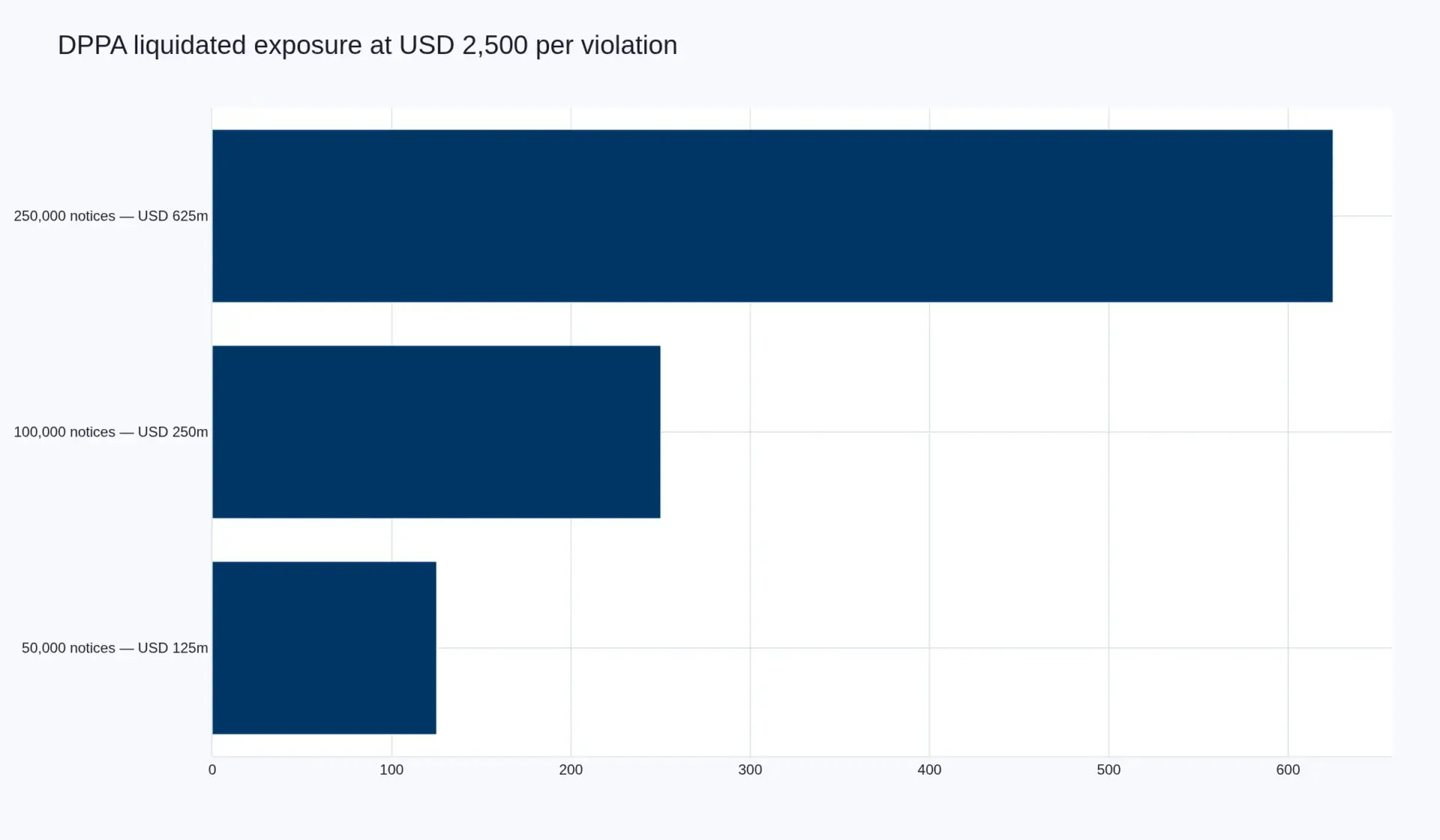
| Notices in the class | Liquidated damages before fees | What that represents |
|---|---|---|
| 50,000 | USD 125,000,000 | Twice the annual revenue of a mid-sized regional patrol contractor |
| 100,000 | USD 250,000,000 | A material event against a company valued at approximately USD 5 billion |
| 250,000 | USD 625,000,000 | Existential for any private operator that is not publicly listed |
Neither of the first two figures requires proof that anyone was harmed, because the statute does not require it. That asymmetry — not the technology — is what determines who can afford to issue a private notice at scale.
The Alhindi theory is not exotic
The proposed class action against Metropolis alleges that motor vehicle records were obtained outside the permissible uses in order to mail notices designed to resemble government citations. It has not been finally determined, and we make no prediction about the outcome. What can be said is that the theory rests on the plain text of the permissible-use provision rather than on a novel reading of it, and that every participant whose model depends on privately issuing notices from state records carries the same exposure regardless of how the Metropolis matter resolves.
The operational checklist that follows is short and unforgiving:
- every keeper lookup must be attributable to a documented permissible use;
- the delegation from the authority must be real, current and in writing;
- retention, resale and redisclosure rules must be respected, with the recipient record kept for five years;
- and the notice must not misrepresent who issued it.
That last item is the cheapest thing in this market to get right and the most expensive to get wrong. A private notice dressed as a government citation converts a pricing dispute into a statutory claim with a per-violation multiplier attached. Compare the SP+ and Q-Park margin gap in our concession research: the contract form decides the margin, and here it also decides the liability.
Three regimes, three very different positions
| Regime | Who issues the penalty | Who holds the keeper data | Commercial consequence |
|---|---|---|---|
| United States, private lot | Private operator, under delegation | State DMV record, obtained through the DPPA’s acting-on-behalf clause | Highest margin per transaction and the highest statutory exposure |
| England and Wales, civil enforcement | Local authority; patrol capacity contracted to a supplier | Authority | Supplier sells into a budget protected by statute and measured annually |
| Western Europe, bounded delegation | Public authority retains the penalty | Authority remains data controller | Legally more robust; materially less lucrative per transaction |
In most of Western Europe the contractor operates inside a bounded delegation that keeps the data-controller relationship with the state. Automated decision-making that produces legal effects on an individual is restricted under Article 22 of Regulation (EU) 2016/679, with human intervention available as the safeguard, which places a floor under the human component of adjudication and therefore under its cost. That is a better legal position and a worse revenue position, and participants price it accordingly.
Configuration has become a line item
California’s Assembly Bill 503, approved in October 2017 with an implementation deadline of 1 July 2018, required cities to offer payment plans for unpaid parking citations to qualified indigent individuals who request one. Santa Monica’s response is documented: it purchased an instalment-payment-plan software module for an estimated USD 61,250, then extended plans to all recipients rather than only qualifying ones, because the module cost was fixed and a broader offer lowered the average cost per plan.
A small transaction and an important precedent. Penalty administration is now a regulated service with configuration requirements, and those requirements are priced into the processing contract rather than absorbed as overhead. Language access, remote hearings, evidence disclosure at review and retention limits will each follow somewhere, and each will arrive as a line item. In a market where Conduent processes 1.9 million violation payments a year and collects more than USD 850 million annually for citation and delinquent accounts, the configuration surface of the software is the contract.
Three things that would move the perimeter
A narrowing of the DPPA’s acting-on-behalf clause would end private-lot citationing in the United States and channel that volume back through municipal contracts. A state repealing its subsection P equivalent, extending retention and audit rules to parking regulation, would raise the cost of capture materially inside that state. A large DPPA judgment against a recognition operator would reprice every company whose model depends on privately issuing notices. None of the three is imminent. All three are cheaper to prepare for than to litigate, and the preparation is the same in each case: a documented delegation, a purpose-limited lookup, and a notice that tells the truth about who sent it.
What this does to the market number
The market this sits inside is worth USD 4,020.0 million in 2025 and reaches USD 8,760.0 million in 2033 at 10.23 per cent. But the split underneath is where the legal analysis turns commercial. Field enforcement — the patrol hour, the handheld, the vehicle-mounted camera — holds 41.0 per cent of the value and supplies only 28.1 per cent of the growth. Citation processing, adjudication and collections take 37.1 per cent of the increment. Digital permitting takes 34.8 per cent and lifts from 22.1 to 29.0 per cent of the pool, because a permit is an annual relationship and a citation is a single event.
None of that is a technology forecast. Value moves toward the register and the back office precisely because the legal asset is not the algorithm — it is the authority to identify a keeper and to collect from one. The related markets tell the same story from different angles: the curb is a schedule rather than a car park, the gate is now sold by the transaction, and the sensor that gets bought is the one that isn’t installed. In each case the durable asset is the record, not the hardware.
Which is why a paragraph of Virginia statute, four lines long, describes this market’s risk better than any product roadmap.
Sources and method
The primary research programme behind this analysis comprised 27 semi-structured interviews across six markets, nine conference-floor interviews, one closed roundtable with revenue officers from four authorities, and 41 survey responses. Estimates drawn from that programme are labelled where they appear in the underlying report: enforcement technology at 6 to 11 per cent of field enforcement cost, top-ten concentration at 18 to 22 per cent, and enforcement and patrol contracts transacting at 6 to 9 times EBITDA. No third-party market research is cited in this piece.
References
- Virginia Code, Chapter 55.6, §2.2-5517, as enacted 2025 c. 720.
- Virginia State Crime Commission, ALPR approved-vendor and annual-reporting checklist.
- 18 U.S.C. §§2721–2725, Driver’s Privacy Protection Act, including §§2721(b)(1), 2721(c) and 2724(b).
- Alhindi v. Metropolis Technologies Inc., complaint as reported.
- California Assembly Bill 503 (2017), and City of Santa Monica council reports on payment-plan implementation.
- Regulation (EU) 2016/679, Article 22.
- Metropolis Technologies, financing notice, November 2025.
- Conduent, transportation segment fact sheet.
- Pheonix Research, Global On-Street Parking Enforcement & Digital Permitting Market, Size, Share and Forecast 2026–2033.